Coffee+Brownies=Mad Father… But can I do it anyways?
TL;DR: This individual is concerned about whether or not she is an a-hole for baking brownies with coffee in it because her father does not like coffee in them. She has gotten into baking since Covid started and has become very interested in the subject. Her father asks her to remove the coffee but she is adamant that it is up to her as to what goes into the brownies. Her father eats the brownies nonetheless, even though there is coffee in it and still complains to her. She is wondering if she is the a-hole for not adding coffee even though her fathers hates coffee, yet he eats it anyways.
In the above scenario, the brownies were made for the individual and not for the individual’s father but the father was upset that there was coffee as an ingredient of the brownies and yet he ate the brownies knowing that there was coffee in them. The individual wants to know if they are an asshole for including coffee in their personal celebratory brownies and based on Mozi’s philosophy we have decided to assess the consequences of this action rather than the intent. There are two possible options that could occur: the individual includes coffee in their brownies or they do not. The consequences for keeping the coffee in the brownies yield 3 happy family members who eat the brownies, and 1 unhappy family member that still eats the brownies. The consequences for removing the coffee from the brownies results in 2 family members that eat the brownies but do not enjoy them as much as if they had coffee, 1 very happy family member who eats the majority of the brownies leaving fewer and less tasty brownies for the rest, and 1 very unhappy family member who dislikes having their recipe altered and having their father eat all of their brownies. It is clear that the less desirable result for the majority occurs when the coffee is removed so by removing the coffee, the individual would be acting partially toward their father. Mozi condemns partiality,
Mozi 68
“The business of a benevolent person is to promote what is beneficial to the world and eliminate what is harmful”
Relating to Mozi’s quote, in order to bring the most benefit and eliminate the most harm, the individual must consider the above mentioned consequences and consider what would bring the most good to the majority of the family. From this, we can conclude that because the individual in the scenario discovered this recipe prior to this instance, and when they first added coffee all 4 individuals in the household enjoyed the brownies and ate them but only the father got upset about the ingredient. Because the father still eats the brownies regardless of whether they contain coffee or not, by adding coffee the individual is bringing joy to 4 people. If the individual had not included coffee, they personally would have been upset and enjoyed the brownies less and given that the mother and brother prefer cooking with added ingredients, it is likely that they would also enjoy the brownies less. Therefore, although the coffee ingredient angers their father, the coffee is still bringing joy to the most number of people. Therefore it would not be treating everyone impartially to take away an ingredient that the majority prefers just to satisfy the minority. Similarly, the brownies in question were made for the individual only but the father still ate 3 of them willingly and knowing that they contained coffee. We do not consider the individual to be the asshole.
Do I have a moral obligation to pay medical bills for someone I hit with my car even though I was not at fault?
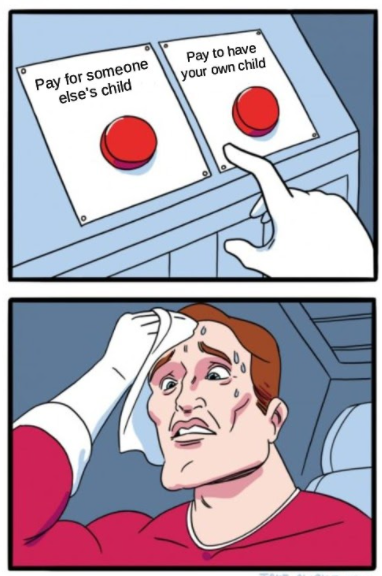
TL;DR: This individual was driving home from work on a 4-lane road with a 45 mph speed limit that has a divider in between the lanes. A group of teenagers were standing on the divider waiting to cross once the traffic lights changed. The traffic lights did not change and a teenager decided to walk right in front of the car. The driver slammed on the breaks but could not swerve due to other cars driving right next to her. She ended up hitting the teenager and he ended up with injuries but survived. The teenager knowingly walked in front of oncoming traffic without a change in traffic lights and ended up getting it. Even if the driver could have stopped in time, the other car over probably would have hit the teenager. The driver was sued by the teenagers parents and ended up being found not at fault every time. The parents of the teenager think the driver should be paying most if not all of the medical bills of the teenager, even though it was 100% the teenagers fault. The driver believes she has a moral obligation to pay at least some of the medical bills. The driver and her husband are already planning on having a child via IVF, which is expensive as it is, but the husband has a moral conflict as to whether or not they should pay the bills to the injured teenager or have their own child (via IVF). The individual is wondering whether or not she is the a-hole for not paying for the injured teenagers medical bills.
Mozi represents objective consequentialism and is therefore only concerned with the resulting outcome. Here, Mozi would most likely tend to side with the driver as the events transpired and the consequential results do not promote moral goodness. To accomplish this, actions must promote enriching the poor, contributing to the population, or establishing order. This specific situation offers a unique perspective as the events conflict against each other in Mozi’s criteria analysis. “Looks at consequences of either action: not helping and helping. Do these consequences align with promoting enrichment of poor, increasing population, and making order,” (80). By knowingly defying the law and refusing to cross at the properly designated locations, this individual is incorrectly assessing the situation and not accounting for others in considering the consequential ramifications for their actions. After the damage has been done, it is unrealistic to expect the driver to pay for another’s mistake, although, according to Mozi, some consideration should first be examined. While paying the pedestrian’s family would satisfy Mozi’s first criteria of enriching the poor, in this specific situation where the pedestrian remains completely at fault, answering this question still remains difficult today. Assessing the second criteria does not appear to clarify the answer further as ensuring the driver pays reparations to the pedestrian would be indirectly withholding funds the driver’s family planned for their first child.
Mozi 69
“If people regarded other people’s families in the same way that they regarded their own, who then would incite their own family to attack that of another? For one would do for others as one would do for oneself”
Here, a quick glance at a role-reversal scenario illustrates how indirectly taking money planned for the birth of a child is most likely interpreted by each party in the same manner, it is unreasonable to expect. The last criteria is the tie-breaking vote; by paying the reparations, the driver may accumulate negative affect and emotions towards having to pay large sums of money to someone who foolishly made a very dangerous decision that put both themselves and the driver in harm’s way. In this way, the driver’s family loses money, meaning they potentially may not be able to afford the procedure to give them a child, or must wait again to save enough to complete the procedure later on only increasing the likelihood of complications with the woman’s increasing age.
In addition, while the pedestrian’s family shouldn’t be punished for his mistakes, having the innocent driver pay prevents any learning to occur. While unjust, the decision the pedestrian made should be paid by that individual alone yet, seeing as medical expenses divert to the family, while unfortunate, owning up to the consequences of parenting and decision making should be kept to the side at fault. The animosity experienced by the pedestrian’s family is not comparable to the disorder caused by an innocent family having to sacrifice their hard-earned money to pay for the damage of a mistake made by a young adult.
Considering both situations where the driver does or does not pay in accordance with Mozi’s criteria does not give one concrete morally correct answer but does reason the better choice, all things considered. If the driver does not pay reparations, according to the criteria set by Mozi, it would be most morally logical that the pedestrian’s family pay alone, ensuring the pedestrian heals properly, with some financial burden as the consequence for their actions while the driver’s family can continue to plan to have the procedure done and start a family, effectively contributing to the population and increasing order in society.