Deal with the Racist

My grandpa is a racist. But he is also rich. And we are poor.

He just got diagnosed with cancer, and he will die in 9 months. He is writing his will, and I want to inherit some of his money. So, I plan to visit him in the hospital everyday until he dies. I will listen to his stupid world views and racist comments. I will agree with him, and express my own hate. This will be a lie, of course.

Would I be the asshole for doing so? (excerpted from r/AmItheAsshole)

The English philosopher Thomas Hobbes takes it as a given that all human beings are self-interested (Leviathan, ch. 13). So, you have your self-interest of getting that money, and your racist grandpa has his self-interest of advancing his worldview. There is nothing inherently right or wrong with your self-interests, and you each have the freedom to pursue it.

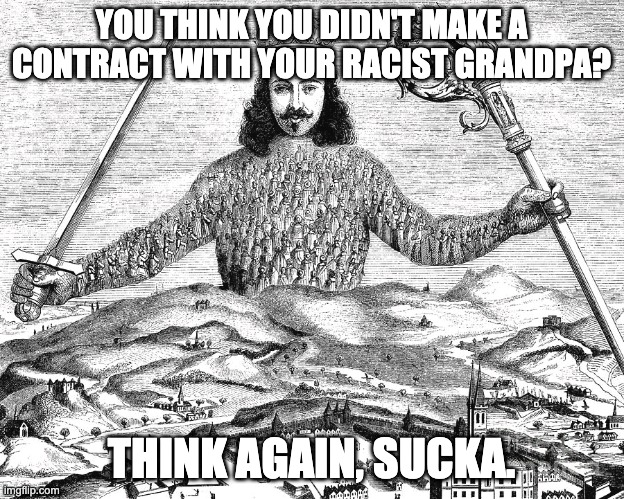
However, Hobbes also believes that, as members of a society, we give up some of our freedoms for security, through the formation of contracts (Leviathan, ch. 14; see especially para 4–5). Now, on the first pass, you might think that there is nothing wrong with you pretending to be a racist too so that your racist grandpa will leave you with some cash, since no explicit contract was written down. But, like much of moral philosophy, the matter is a little more complicated than initial appearances.

Hobbes says that, in thinking about our moral obligations, we cannot only pay attention to the explicit contracts, but we have to pay attention to the implicit contracts, or contracts made by inference, as well. In particular, he thinks that implicit contracts can be

“sometimes the consequence of contract by words, sometimes the consequence of silence, sometimes the consequence of actions, sometimes the consequence of forbearing an action, and generally a sign by inference, of any contract, is whatsoever sufficiently argues the will of the contractor”

Thomas Hobbes, Leviathan, ch. 14, para 14

So, in this case, we also need to ask whether by taking the actions of visiting him in the hospital and pretending to agree with his racist world views, you have implicitly formed a contract with him that you will continue to uphold these racist world views, in exchange for the inheritance from him. The fact that you recognize that you are—let’s not use the word “lie”—staging a particular performance for the sake of the money suggests to me, in my Hobbesian hat, the formulation of an implicit contract.
Watch out for the implicit contracts you make!

Finally, on Hobbes’s view, “INJUSTICE is no other than the not performance of covenant” (Leviathan, ch. 15, para 1). In other words, the morality of your actions is solely determined by whether you have fulfilled your contract or not. That is, how the money gets spent and what good they do are all completely irrelevant to morality from the Hobbesian perspective. You can’t try to justify your actions on the ground that the money may be spent for beneficial or reparatory ends. Hobbes doesn’t care that you will give some money to your parents who have been harmed by your grandpa, and he certainly doesn’t care that you will use the money to pay for college. Instead, he only cares that you have failed to perform the contract you’ve made—even one that was made through your deeds and not your words. So, yeah, you would be the asshole if you pretended to be a racist in order to get your racist grandpa’s money.

By the Professor
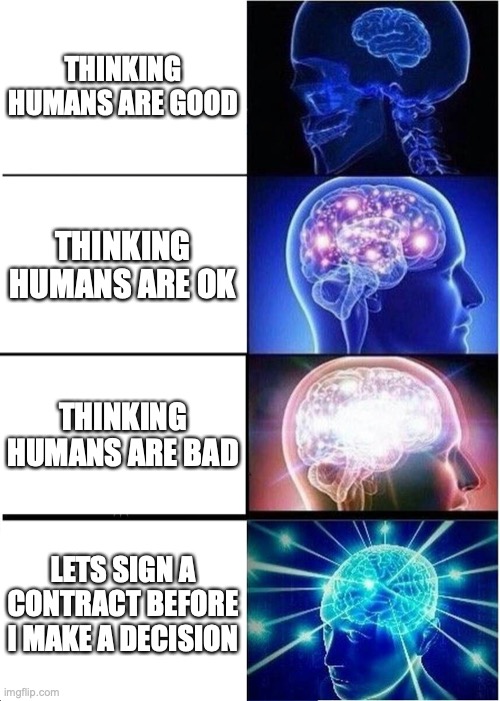
No Contract, No Problem

TLDR: OP is debating whether to pretend to agree with their wealthy grandpa’s extremely racist views for the chance to get inheritance money to pay for college. OP’s father does not want them to do it, as the grandfather had previously disowned OP’s parents due to their interracial marriage and nontraditional family structure. OP and some members of their family are open to the idea because they will be donating part of the money and using the rest for a practical and potentially-life changing cause.

Many paint Hobbes’ conception of morality simply as Psychological Egoism – the view that we are moral simply because it is self-serving. However, this ignores the logical argument that he makes to arrive at his view, and is too simplistic to effectively articulate his conception of morality. Hobbes posits that, in the state of nature, humans would be in competition with each other and have every motivation to hurt others at the expense of their own needs. This, he argues, makes any agreement between them uncertain, as each has greater motivation to betray the other than to honor their agreement. “Before the names of just and unjust can have place, there must be some coercive power to compel men equally to the performance of their covenants by the terror of some punishment greater than the benefit they expect by the breach of their covenant,” Hobbes suggests (Leviathan 99, 107). This model, in which people collectively sacrifice a few small liberties in order to establish rights (protected by a sovereign authority), creates his contractarian view – that morality exclusively comes from contracts between people which are enforceable. Moral congruence comes only from the existence of a contract, despite the content of it, and the fear of pressure binds people to follow it. Hobbes also considers people and actions to have separate moral guidelines (to an extent) – breaking a single contract in good faith does not make you an unjust person, and keeping agreements does not automatically ensure that you are personally just.

Jack’s opinion:

I think that Hobbes would consider this to be a morally justifiable action. The lack of any contract or agreement between the two means that there are no specific agreements that the grandson would be breaking. As specified in the post, the grandson is not attempting to make a deal with the grandfather but rather is hoping that he will choose (of his own will) to create a covenant that gives OP a share of his money when he dies. While the poster’s intentions, to “listen to his stupid world views and racist comments. I will agree with him, and express my own hate (this will be a lie of course),” seem to include deceit, there is never a mention of a quid-pro-quo agreement or any promises being made about future action. Hobbes seems to confirm this – he writes that “for to covenant is an act of the will, that is today, an act, and the last act, of deliberation, and is therefore always understood to be something to come.” The grandson is hoping for something to happen from his actions, but is never promising something in return or asking his grandfather for any money directly. However, he writes that “covenants entered into by fear … are obligatory.” While he outlines several ways in which economic, social or physical coercion can still produce valid agreements, there is never an explicit discussion of whether lying and deception can be the foundation of moral agreements. Despite that, in this instance, the grandson does not appear to be breaking any agreements and is acting within the laws of nature, minimizing his moral responsibility from a Hobbesian perspective.

Cailin’s opinion: 

In order for this person to not be the asshole, they would need to enter a contract with the grandfather meaning there would be the promise of being included in the will or a contract stating that they will be nice in exchange for being included in the will. However there is no contract formed and no word for this person to keep. They are only acting in self interest. However this person also isn’t breaking any contracts either so this appears to be a neutral act.

Toby’s opinion:

This person is not being an asshole. Yes, it is an immoral and wrong thing to do, but when you take into account the needs for the money and how it will go to charity and an education I see no problems with it. Also it is important to note that when someone dies they can’t make anymore decisions about their money, thus it really doesn’t matter. They are acting in both self interest and interest for the greater good (charity) but because racism and anti semitism is not for the greater good, as well as understanding that the grandparent will die soon, it is a very “Non asshole” action.

By Group 4 (JC, CL, JO, TS)

Hobbes: AITA?

Tl;dr of your situation: your grandpa is a real POS. But a rich POS (of course). He hates your family, but you are considering sucking up to him by putting up with and echoing his racist beliefs in order to get written into his will. Assuming it works out, you will use your new-found money to pay for college and to give away to charity. Your mom is all for this idea, but your dad isn’t convinced. What to do?

I’m about to answer this question with a little help from Hobbesian morality. Hobbesian morality is all about keeping your promises (covenants) with people. As long as two parties make a covenant with full knowledge of making it as well as what it entails, the covenant is said to be valid. To keep your covenants is moral, to break them immoral. And prior covenants always take precedent over later ones.

Now, here’s my answer: suck up to that POS. Go as nuts as you want, your morality will remain intact. Just like Obi-Wan, you will have the high ground. Assuming that you are able to convince your dad that this is a good idea, though. This is because (if your dad is okay with it) you will not be breaking any covenants (assuming that you haven’t made a covenant with your grandpa to NOT suck up to him, which I doubt) with any party. From my understanding of your situation, as long as you are able to get your dad on board with this, you will indeed NOT be the asshole according to Hobbesian morality, because you will have violated 0 (zero) covenants. Hell yeah.

By Group 1 (LG, SK, GON, CS)

Racist Grandpa

The scenario of the “Racist Grandpa” discusses a grandson being in a moral dilemma towards his Grandfather. The grandson describes his grandfather as a “jerk” because he holds anti-Semitic, racist, and xenophobic views. He has a swastika tattoo and proudly announces his dislike of others to his own family. The dilemma arises where the grandfather is ill with cancer and has 9 months to live. The grandson, who vehemently disagrees with his grandfather’s views, wonders if he should visit him and join in with his racist slurs to gain benefits within the will. The grandson has conflicting views on this action/topic as his mother is all for it while on the other hand he/his father are weary.

Hobbes’ view of morality and human life is based primarily on self-interest. Hobbes believes it is one’s nature to live a life of self interest in the hope of gaining one’s desires.  Hobbes believes that all men are made equal but “From this equality of ability ariseth of hope in the attaining our ends” (94). Hobbes believes that due to human equality it is our duty as people to “attain […] our ends” which suggest that it is moral to pursue our own desires which exhibits the morality of self-interest. Hobbes further states that “The passions that incline men to peace are fear of death, desire of such things as are necessary to commodious living, and a hope by their industry to obtain them” (97). Hobbes is stating here that morality is driven by “fear of death” which affects our decisions regarding our preservation. He also states that it is our duty “to obtain them” as they benefit our self-interest further revving morality is based on self-interest. Finally, Hobbes idea of morality based on self interest is further exhibiting when he writes, “The right of nature which writers commonly call just natural, is the liberty each man hath to use his own power as he will himself for the preservation of his own nature; that is to say, of his own life” (98). Hobbes comparing “the right of nature” to “the preservation of […]  life” exhibits it is within man’s power and right to live by self interest if it leads to his conservation.

From Hobbes perspective of morality and self interest he would believe that the grandson lying and taking the cash would be morally ok. Hobbes would believe this because he discusses that morality is based on self-interest and preservation. The grandson says that if he receives the money he would “give 25% to charities, 25% to my dad, 25% for my mom, and 25% to me to help pay for college”. His actions of not only caring for his own self preservation and education but those of others is an indicator that it is in his right to take the money. Hobbes would believe this because, as stated within the previous paragraph, we as people can obtain our ends to secure our preservation or “commodious living”. As well, it would be morally ok for the grandson to “hope to obtain” the money through the transaction of sucking up because Hobbes believes no gift is free. This idea is seen when he writes, “When the transferring of rights is not mutual, but one of the parties transferred in hope to gain thereby friendship or service from another or from his friends; or in hope to gain the reputation of charity or magnanimity, […] , is not a contract, but a GIFT, FREE, GIFT, GRACE” (101). Although there is no verbal agreement between the grandson and grandfather in getting the money the grandson is giving up his rights in the present to ensure his future that he will reap benefits. Hobbes states it is moral to have hope of self interest in one’s future to gain the reputation of “charity or magnanimity” which the grandson is striving to do. The grandson hopes to gain magnanimity to obtain his grandfather’s approval to be written within the will. Finally, Hobbes states,“The matter or subject of a covenant is always something that falleth under deliberation; for to covenant is an act of the will that is to say, an act, and the last act, of deliberation, and is the for always understood to be something to come […]” (105). Within the grandson to grandfather scenario the line “act of deliberation […] is always understood to be something to come” connected to a covenant, reveals that the hope of preservation or benefits based on self-interest for the future is what morality is based upon. The grandson is taking care of his future and “something to come” through his own “act of deliberation” or befriending his racist family member which implies through Hobbes view of morality that a life driven on self interest is not only normal but moral. This would mean it is within the grandson’s right to act upon his future whether it is selfish or not.

By Group 2 (IB, AC, JL, EW)

Hobbling for Inheritance

TL;DR: An individual wants to “suck up” to their dying racist grandfather, with whom they do not like and neither do their family members, in order to be written into their grandfather’s will for his inheritance. The individual tried to make his grandfather’s last days the best days that included a sense of comfort and a feeling of love. 

Dolla Dolla Bills, Y'All

By Hobbesian technicality, the actions of both actors are moral when you consider their specific contract. The implicit contract in question is that everyone has a right to be in their family member’s will (should they already have been included).

Hobbes’ views on morality remain ingrained in a set of laws that, they themselves, define morality for the society. One way this is accomplished is through a set of binding contracts (based in these laws) that individuals make with others to perpetuate morality through to others. It would be immoral to break that contract. This concept conflicts with the situation in a few ways, first there is the issue of whether or not Hobbes would even see a contract here considering the grandfather was not fully aware of the full extent of their interactions.

If we do consider there to be a real contract, the actions of both the grandson and the grandfather are moral because they both are fulfilling the commitments/actions required on their part to complete the contract. This, of course, is rooted in Hobbes’ idea that morality is based on the rules and contracts we make and enter; thus, this would be moral because the contract was not broken.

By Group 3 (RF, ML, RM, NM, KR)