Death Upon Trump and Mr. Bič

Buss argues that manners are vital to Kantian ethics as appearing respectful is to treat someone in a way that acknowledges their intrinsic value. But Buss also acknowledges that there are some key differences between manners and morals for instance manners encourage us to be agreeable, manners are about appearances, and manners are culturally relative. These differences are notable, but do not undermine manners’ moral significance.

While manners might not be synonymous with morals, the two ideals are closely connected as “making oneself agreeable to others is not only an end in itself; it is also, and more importantly, a means to treating them with respect” (798). In other words, Kant states that to act morally, all people must be viewed as an end in and of themselves not merely as a means to an end. Manners help promote this view through the fact that “good manners, then, not only inspire good morals. They do so by constructing a conception of human beings as objects of moral concern” (800).

Moreover, Buss also mentions that “social disharmony could not fail to adversely affect people’s willingness to regulate their behavior according to certain principles of justice” (799) for three reasons. First, people who are angry and resentful are less likely to help others. Second, people who are disagreeable alienate themselves from others and don’t care about their wellbeing. Finally, people who aren’t in the habit of treating others with respect are not conditioned to seeing people’s inherent worth. Therefore, Buss states that morals are significant for Kantian ethics as they are necessary to promote and cultivate the respectful treatment of all humans.

Wishing Death Upon Trump

Are individuals justified in wishing death upon trump? 

Trump does / did lots of bad, morally wrong shit. Lots of people think the world would be better off without him in it, and some even wish for his death. Is this morally wrong through Buss’ framing?

Our group thinks that there is an important distinction between wishing something would happen and verbalizing that wish. One is a thought while the other is an action that has an effect on others. We’re going to focus on the implications of verbalizing these wishes, because that’s what we’ve deemed most applicable to Buss’s theory. Manners are acting in a way that may not necessarily be in line with your thoughts due to social norms and protocols. Manners are a method of appearing respectful to others. We do this to exhibit that we view other people as ends, rather than just a means to an end. 

It is impolite to verbalize a death wish for anyone because it disregards that people are ends in themselves. Buss believes that regardless of what a person has done, it is still impolite to be rude to them, because it is displaying that you don’t care about their life or acknowledge their intrinsic value as a person. Even though Trump has shown a complete disregard for the humanity of others, Buss still claims that we should extend that nicety/formality to him.

Just because it is impolite, does this mean that it is also immoral? Buss would say yes, it is immoral, because treating people as a means to an end is not acknowledging their special dignity. Every person has inherent value, and we act politely because we directly acknowledge that they are worthy of respect (802). According to both her and Kant, all people deserve to be treated with respect, regardless of whatever unjust or immoral actions they may have taken themselves. To treat another person any other way is thus immoral.

Mr. Bič

In this problem, we are introduced to a man who works at an international company. At this company it is customary to refer to people via their last name. This man, who’s last name is Bič, is from Czech Republic and most of the people he works with are from the United States. When his American coworkers say his name it sounds a lot like Mr. “Bitch”. Many of the people who work with them do not wish to use this to refer to him as they work from home and are around their families for most of the work day. At first his coworkers called him Mr. Birch but he felt slightly offended and corrected them which led them to request a new representative from the company. Due to the drastic difference in time zones he is the only one capable of working with them. This management has pressured him to accept being called Mr. Birch but he believes that this is unjust and he might even have grounds to file a discrimination complaint.

By not referring to Mr. Bič by his proper name, the Americans are not only disrespecting him but also the company custom of calling people by their last name. Buss states that “good manners, then, not only inspire good morals. They do so by constructing a conception of human beings as objects of moral concern” (800). This shows, for both Buss and Kant, that when his coworkers choose to not use his proper name they are not treating him as an object of moral concern which means they are treating him as a pure means. Buss shares their belief that “social disharmony could not fail to adversely affect people’s willingness to regulate their behavior according to certain principles of justice” (799). This statement tells us that by not using Mr. Bič’s proper name they are pushing him towards being resentful by not treating him as though he has inherent value by refusing to call him by his name.

In Buss’s article, she makes the argument that manners are very important especially within Kantian ethics, this situation Mr. Bič has found himself in shows the clashing of two different cultures. In his culture, Mr. Bič means “the whip”. Even though the American staff feels as if they are breaking their own moral code by using a perceived curse word in front of their families they are actually disrespecting Mr. Bič and the company custom of using a person’s last name. Discussing this particular situation with their families could easily solve any moral code they think they are breaking by using his real name while also granting him and the company custom the amount of moral concern they are entitled to.

Synthesis

Both of these problems have to do with disrespecting a person by not acknowledging their intrinsic value. Though one is on a greater scale of wishing death upon someone, and one is on a smaller scale of mispronouncing someone’s name, both are immoral because ultimately, treating someone disrespectfully means viewing them as a means rather than an end. Even in a case like the first one, where the person in question has committed immoral acts themself, it is not up to us to judge how that person should be treated. At the end of the day, we are all human beings and all human beings have an inherent value, thus making them worthy of respect. 

What To Do About My Terribly Dysfunctional Family

WIBTA for not apologizing to smothering in-laws?

TL;DR: This woman is having her first child with her husband. The husband’s parents have never really paid them any attention until they found out that their son and daughter in-law were going to have a child. So, the parents began involving themselves into much of their kids’ lives; Often giving their opinion about decisions that are not theirs to make and imposing themselves upon their kids’ lives. It has gotten to the point that both the husband and wife have told the parents to back off, yet they do not and continue to impose their wishes and opinions on the lives of their kids. One day, the newly pregnant wife was minding her own business and the parents showed up and began berating the wife. She couldn’t take it any more and lost her temper, blowing up on the parents and telling them that they are not welcome around her, her family, and her house. The parents ended up leaving hesitantly and other family members from the husband’s family are demanding an apology from the wife. The husband thinks that she should not apologize and the wife is wondering if she is an a-hole for not apologizing. 

In the above scenario, both the wife and the smothering in-laws have both failed to treat each other respectfully. The wife shouted for the in-laws to leave and the in-laws called the wife an “ungrateful bitch” and were trying to control the wife’s entire pregnancy. While both are in the wrong, our advice for the wife stems from Buss’ moral philosophy based on mutual respect and treating others with dignity. Buss writes, “to treat someone ‘with respect’ is to treat her in a way that acknowledges her intrinsic value, or ‘dignity.’ This is a value she has no matter what her deeds and accomplishments may be; it is tied to what she is, not to what she has done” (797).

Though the husband’s parents acted in ways that irritate the wife, Buss advises that the wife should still treat them with dignity and respect because they still have intrinsic value, even though she might think their actions do not. The in-laws certainly treated the wife without dignity, but the wife’s response should be to apologize. When the wife snapped back at the in-laws she failed to acknowledge their dignity in that moment. It is for this reason that regardless of what the in-laws had done, and whether or not it was justified, the wife should apologize. Similarly for the in-laws, regardless of the wife’s actions, they too need to apologize. Our advice is to then have a calm discussion with the in-laws in which the wife apologizes for her yelling, and then facilitates a discussion about her and her husband’s needs and how they alone should make the decisions about their child in order to prevent future situations like this.

AITA for refusing to hug my cheating mum?

TL;DR: This individual found out that her mother was cheating on her dad with another man that she had met through a mutual friend. The mother has been sending explicit messages and photos back and forth with the other man without her father knowing. The individual confronted her mother and her mother promised that she would stop. Eventually the mother told the father but had omitted the truth about the types of messages being sent to the other man. A month passes and the individual finds that her mother is still sending messages, so the daughter confronts her again. The mother swears on her grandchildren that she will stop, but she does not stop. A week later, her mother asks for a hug, but the daughter cannot and has not forgiven her for manipulating her father and consistently lying, so she politely denies the hug from her mother. The mother then becomes angry and storms out of the room. The daughter doesn’t want a relationship with her cheating mother and has been informed from her father that her mother now hates her. The daughter is wondering if she is the a-hole for not wanting to hug her mother.

Buss’s main argument, in relation to Kant’s philosophy, demonstrates that morality is the result not merely of agreeableness, but in demonstrating respect and dignity for others. Just as we would want for ourselves, we too should show respect through societally agreed upon activities and events that quickly establish a mutual groundwork of human deference. Morality does not come from simply performing these actions but in genuinely conveying and meaning to show respect and caring of others, again, as we would expect for ourselves. In this particular situation, it is clear to see the mother is not respecting anyone in her family by continuing to flirt with another man. This can be seen from multiple perspectives and each view results in the same conclusion; the mother’s actions are both immoral and disrespectful to her family members as well as herself.

However, regarding the author of the post, in answering this question, “am I the asshole for not hugging my mother,” Kant and Buss would most likely agree that the daughter is also demonstrating immoral behavior. While her actions may be warranted due the mothers immoral behavior, the daughter is responsible for her own actions which she can justifiably choose, unlike her mother, to take the moral high ground. Personal emotions may prevent her from physically showing affection, withholding this affection will not solve her problems, only exacerbating them, demonstrated in the mothers tantrumatic response.

Although a less favorable path, the daughter should apologize and should try to come to a solution of talking with her mother rather than withholding affection as an incentive for her to stop cheating as this demonstrates very little respect or dignity. As Buss states, “human beings deserve to be treated with respect, that they are respectworthy, that is, that they have a dignity not shared by those whom one does not bother to treat with such deference and care” (Buss, 801). Whether or not the mother responds with moral actions is unpredictable but according to Buss and Kant, moral action dictates the daughter should own up to her mistake, openly voice her concerns, frustrations, issues with her mother, and eventually accept the mistake and person for who her mother is.

Means to an End

Kant on capitalism and moral obligations to others.

In terms of the ethical standard problem, Kant states that “the categorical  imperative is thus only a single one, and specifically this: Act only in accordance with that maxim through which you can at the same time will that it become a universal law,” (Ak 4: 421). To determine whether or not the maxim is universalizable one must first establish the maxim, then consider what the corresponding universal law would be, and finally determine whether or not this universal law is plausible or if it presents a conceptual contradiction. If a maxim being universalized presents a contradiction then one must not do it because it is  “impossible to will that  their  maxims  should  be  elevated  to  the  universality  of  a  natural  law, because  such  a  will  would  contradict  itself” (Ak 4: 424).

Kant also presents a second way of considering his ethical standard saying that one must treat “the  human  being… as end in itself, not merely as means to the discretionary use of this or that will,” (Ak 4: 428). This is to say that one cannot simply use another human being as a means to an end but instead must consider them as an end in and of themselves. Kant also distinguishes between perfect duties, which are the exceptionless imperatives that state one cannot do some action, and the imperfect duties which are those that one ought to do but do not have to do in every situation.

Ethical Consumption Under Capitalism

Is the term “no ethical consumption under capitalism” true? And if so, is it even possible to live a virtuous life if capitalism exists? If it isn’t, is it possible to create an ethical system that allows for virtuous living and what would it look like?

What does Kant define as ethical?

“There is nothing it is possible to think of anywhere in the world, or indeed anything at all outside it, that can be held to be good without limitation, excepting only a good will.”  

(9; Ak 4: 393)

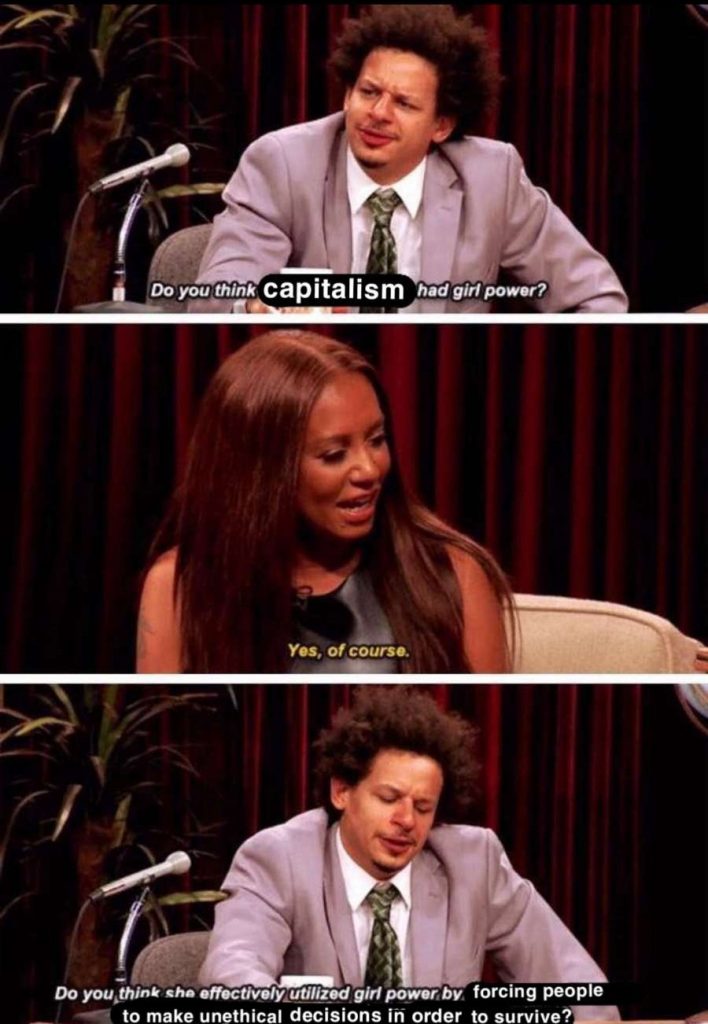
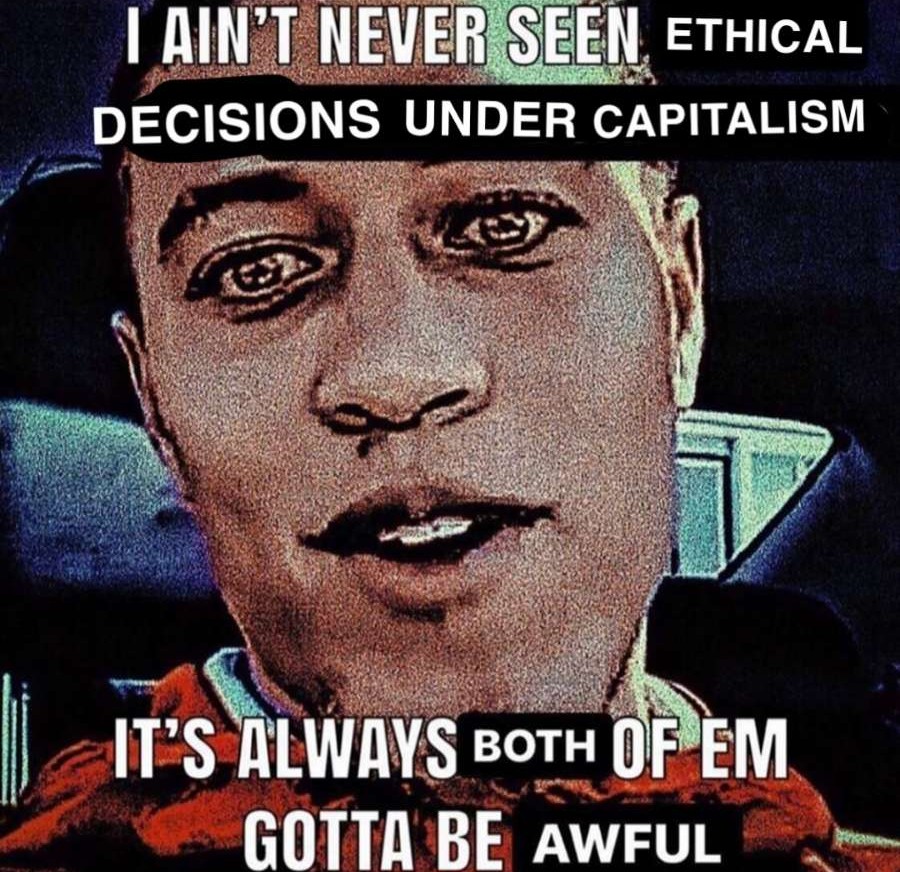
Kant provides a framework that claims that the only thing that is purely good is good will. Kant says that universalized maxims can inform one on how to act. If it cannot be applied to every situation, then it is not an ethical decision. The good place does a good job deconstructing the ethical implications of capitalism. Capitalism is an economic system in which there are the people in charge of the means of production and there are the working class who are often exploited and used as means rather than ends. In order for one group to maintain power and excess of production, another group must be kept down and oppressed. That means that when it comes to consumption, there are hardly any good decisions to be made. A good example of this is in the good place when Chidi is debating what type of muffin to get for breakfast. He is trying to calculate harm reduction and the lesser of two evils, but regardless of the other options, they are both still unethical because of the working conditions people face in order to produce these. Bad things are still bad regardless of the circumstances you have been put in.

Kant would likely criticize the people who formed and participate in this system that gives people little to no option about whether or not they do the right thing, especially because companies and powerful people work hard to mask their immoral behavior. You can’t make autonomous decisions if you don’t have all of the information—the fact that corporations and participants in the system treat workers as means shows that capitalism itself is an immoral system, therefore participation in it is inherently bad.  The only way to act ethically is to defy capitalism—so it is likely that Kant would agree with the phrase “no ethical consumption under capitalism.” This doesn’t mean that you cannot live ethically if capitalism exists but only if you are not an active participant in said society. 

Kant would say that there’s no inherently ethical system for virtuous living, but a better system would allow for individuals to better make informed decisions because they would be aware of the consequences of what the system is doing. A better system would also encourage doing the right thing rather than rewarding people for selfish behavior. The way Kant’s theory works is that people do the right thing out of duty. A better system would be one with more accountability and transparency, which would directly link to more people acting upon these duties and having more ethical options.

To tie this into the trolley problem, categorical imperatives are commands that you must do regardless of your desires. Kant would likely criticize capitalism for being the system that puts people in the position of being tied to railroad tracks in the first place, and putting the responsibility on others to make decisions (e.g. pulling a lever) that would still lead to an unethical decision. This however, does not change the fact that the action you take under capitalism is that you are often forced to pull the metaphorical lever. Even if you are forced to do a bad thing because of your circumstances, it’s still not morally permissible.

Moral Responsibility to Educate Bigoted Housemates

“A is the only minority within an otherwise homogenous group (let’s say B, C, and D are the rest of the members), who all live together under one roof. While each individual in the group has good intentions and are against any form of bigotry, members of the group unknowingly commit micro-aggressions upon A. A vocalizes these concerns to the group, and is met with uncomfortable silence. B, C, and D don’t want to see themselves as bigots, so they choose to ignore A’s concerns. A recognizes that they themself are not responsible for educating B, C, and D on micro-aggressions, and chooses to spend less time in the house. B, C, and D see A spending less time with them as a sign of rudeness (and during the pandemic, they also see it as a lack of concern for their health), and collectively begin to resent A more and more as time passes. 

A is aware of all of this. A wants to educate B, C, and D on their behavior but simultaneously recognizes how futile the endeavor is. A wants to respect themself and their identity by leaving the house, but simultaneously does not want B, C, and D to resent them. Both action and inaction make A’s life more difficult. A does not want to leave this housing arrangement because it would be too financially burdensome, but at the same time recognizes their own deteriorating mental health the longer they stay.

If B, C, and D refuse to change, what obligation does A have to fixing this problem? A can’t completely remove themself from the house, and, with every effort to try to fix the situation, A recognizes that they are being drained of their autonomy and self respect. I am not looking for a solution to this problem (I want to make clear that there is no real one under the condition that B, C, and D refuse to participate), but rather, what obligation does A have to improve their life even if they know fully well that there will be no progress? Is there any obligation to resist oppression at all if all avenues for progress are barred?

An alternative way to say the same question: what obligation does A have in improving their life if both action and inaction result in a net decrease to their well-being?”

There is a lot to unpack here, so I’ll address this in chunks. 

“A recognizes that they themself are not responsible for educating B, C, and D on microaggressions”

If the maxim here is I am not responsible for educating people on microaggressions, then the universal law would mean that no one is responsible for educating people on microaggressions. We’ll say that microaggressions are immoral, because if they go unnoticed, they can lead to worse immoral discrimination against groups down the road. Thus, saying that no one is responsible for educating people on microaggressions is impossible, because microaggressions themselves are immoral, so letting them go unnoticed is an immoral act. So, the maxim becomes everyone is responsible for educating people on microaggressions, and no one is exempt from this. If it is a maxim, Kant would say we have an duty to do it even if it goes against our own desires. So, unfortunately, Kant would say that it is your duty to educate your housemates on their microaggressions. However, the outcome itself doesn’t matter; if your housemates choose not to listen, as it seems they are not, it is not your duty to make them listen. 

“B, C, and D see A spending less time with them as a sign of rudeness (and during the pandemic, they also see it as a lack of concern for their health), and collectively begin to resent A more and more as time passes. “

Kant says we have a duty to not lie, under any circumstances. However, this is different from not telling the truth. If your housemates are not directly asking you why you are spending less time in the house, it is morally permissible to not tell them. But, if they have asked you, it is your moral duty to tell the truth: that you are leaving the house because the environment they have created is uncomfortable. While the truth hurts in cases like this, telling your housemates why you’re leaving the house may lead to a better discussion about the negative environment they have created for you. 

“Is there any obligation to resist oppression at all if all avenues for progress are barred?”

Let’s start by formulating a maxim. Here, it seems like the question would lead us to I will not resist oppression because all avenues for progress are barred. Now, let’s universalize it: Everyone will not resist oppression because all opportunities are barred. If no one resists oppression, no progress in society will be made, and the opportunities that are there will be thrown away. So, it seems like it would be a duty to resist oppression because if one does not, they perpetuate the oppression in society. Just because resisting oppression doesn’t seem to work in every instance doesn’t mean we shouldn’t do it, because resisting oppression furthers humanity and the autonomy of the oppressed communities.

Synthesis

Kant said “Act so that you use humanity, as much in your own person as in the person of every other, always at the same time as end and never merely as means” (AK4:429).  Both problems are problems because they have created a world where it is acceptable to use people as a mere means, like how a cup is used to hold water. The first problem specifically asks about the ethicality of consumption within a capitalist system, Kant would most likely argue that capitalism does treat people as mere objects, so therefore it is an unethical system. This can be seen with companies like Apple and Nike who pay workers in other countries a minimal salary for work in unsafe conditions to produce a product, another example of this is the use of undocumented immigrants in agriculture as a way to pay a fraction of the price for seasonal labor. This system has essentially universalized a law allowing for those in charge of a company to use their employees as a mere means to achieving a large profit, which most people including Kant would say is wrong. 

In the second situation we are faced with a similar but slightly altered conundrum. As per how the situation is described to us it seems apparent that persons B, C, and D find it acceptable to allow for their microaggressions to run rampant and destroy the relationship they have with their fourth housemate. It seems as though this majority is aiming to not be viewed as discriminatory whilst still acting in ways that are bigoted, this in itself is immoral because it creates a world with a condriction. This means for them to achieve this goal they must write off or discredit what person A is attempting to convey to them, phrases such as “it is just a joke” or “you are overreacting” achieve just that. By using similar phrases or by ignoring person A altogether the other three housemates are able to use person A’s emotions against them to ultimately achieve their goal, whether it takes the form of person A being less present around the house or ultimately moving out. So if person A is not around to inform them of the bigotry in their actions then they have no reason to think they are doing anything wrong, which enables bigoted behavior. 

You mean I Kant act on my disagreements with others?

Are individuals justified in wishing death upon Donald Trump?

TL;DR: This person’s question is quite straightforward. They are wondering if wishing death on the person and president Donald Trump is justified. Perhaps this question must be broadened to include wishing death on any person and whether or not that is justified at all. 

According to Kant, yes, individuals may wish death upon Donald Trump because it requires no action. Consider utilization: if everyone were to simply wish death upon Donald Trump (but not actively try to kill him) there would not exist a contradiction. The world would continue to function normally. If we were to take this one step further and ask what would happen if everyone wished death upon everyone else, would there be a contradiction? Our group thinks not because this is not an action, people would not go around killing everyone. Instead, they would have private internal desires for everyone else to die. This does not mean that anyone would die, instead it would foster an individualist society in which we wish death upon others but still partake in cultural norms for our own personal benefit. Most people will choose duty over acting on these wishes and maintain a moral life anyway. Meaning, we can wish death upon others without erupting into chaos.

Kant’s definition of a maxim reveals that morals depend on action, he writes, “Act only in accordance with that maxim through which you can at the same time will that it become universal law” (37). He calls the reader to act with a maxim that can be universalized, but thinking about something would not qualify. Since Kant only deals with actions, individuals are justified in wishing for that death upon Donald Trump so long as they do not act on these feelings.

Can I still be friends with someone who does not believe in gay marriage?

TL;DR: This person has an acquaintance who is a part of the Latter Day Saints Church and does not believe in gay marriage. They have been friends since they were kids and now only know that their friend does not share the same beliefs they do. This person is wondering whether or not they should stay friends or not due to differing beliefs. 

For Kant, this would result in an impossible world because the maxim is contradictory, meaning that it would be immoral to do this. Kant reasons that every situation can be made into a short statement or maxim, which for this case would be ‘I will not be friends with someone if they have a different worldview than me’. After forming a maxim, Kant says that we should universalize or make it applicable to everyone. The new maxim resulting from this would be ‘Everyone should not be friends with someone if they have a different worldview’. Now, we must assess the universalized maxim and look for any conceptual contradictions.

In the context of this specific situation, Kant would advise this individual to continue being friends with his friend because this maxim is internally contradictory. This individual takes issue with the fact that their friend does not support the fundamental rights of another group of individuals. In this particular context, the outgroup here is the LGBTQ+ community but any other racial, cultural, or social group could be imaged as well for the purposes of this analysis. As previously stated, the maxim here is contradictory because if we universalize the act of unfriending someone for having negative beliefs about certain groups of people, no one would have any friends. As Kant states in a similar situation,

“The case could sometimes arise in which [an individual] needs the love and sympathetic participation of other, and where, through such a natural law arising from his own will, he would rob himself of all the hope of assistance that he wishes for himself.”

Kant, 40

If individuals become completely individualized and the maxim of not being friends with someone because of their different worldview becomes universalized, people would have very little friends. Because humans rely on other humans for “love and sympathetic participation”, this maxim is contradictory to will. Therefore, Kant would say that there is an imperfect duty for this person to keep being friends with his friend who does not believe in gay marriage.

Kant Ethics: Testing the Universalizability of Mundane Actions

Are individuals justified in wishing death upon Donald Trump?

Should we wish death upon a sitting president, and is someone justified to do so. The maxim in this is “I will wish death upon someone who is morally despicable to achieve personal gratification. Thus the categorical imperative is the moral obligation that you get when you follow that maxim. Does Trump’s despicable nature justify those thoughts and would Kant believe such a thought to create an impossible society?

The purpose of such thought is primarily to prevent violent action by providing some level of personal gratification. Therefore, this is the maxim for this particular prompt: Everyone who wishes death upon someone who is morally despicable achieves personal gratification. To test its universalizability, we have to argue whether the subsequent law of nature would produce a contradiction. To reach that conclusion, our group discussed the universalizability of the following statement: Everyone who wishes death upon someone who is morally despicable achieves personal gratification. In this specific case, a wish does not constitute a physical action. Wishing things is simply the act of thinking, which by all accounts, is something everyone can do. Moreover, one individual’s thought, if kept to themselves, does not cancel the ability for another individual to think. Therefore, the act of thinking does not produce any contradictions, which according to Kant, confirms that a society is possible to exist under this maxim. This maxim is morally permissible and does not violate the categorical imperative. With this in mind, individuals are justified in wishes directed toward morally despicable individuals.

I have strong romantic and sexual feelings for one of my previous teachers, whom I am very close with, have known for years, and deeply care about. I am of age and she has never made any advancements towards me, but I have this feeling that the bond we have is deeper than platonic. To be honest, I’m not sure if the bond is real or if I’m just delusional. I feel as though I’m betraying and taking advantage of her by thinking of her like this, but the feelings do not go away. I’m worried this will ruin our relationship if I tell her, so I know it’s best to ignore it yet still find it impossible. What are your thoughts?

The purpose of confessing feelings to an authority figure is to achieve full honesty and transparency. The law of nature connected to this maxim is that everyone who expresses romantic feeling will achieve full honesty and transparency. The question of whether this maxim would force a contradiction will be examined in the following paragraph.

Before we advise this individual, we’d like to make a note that, to make our Kantian analysis, we are giving this individual the benefit of the doubt that they are treating their former teacher as both a means and an end. Moving forward, we have identified the maxim of this question as being, I will tell my former teacher how I feel about them to achieve total honesty and transparency. We have also identified the corresponding law of nature, which goes, Everyone who expresses romantic feelings to an authoritative figure achieves total honesty and transparency. Now comes the big question: are these statements universally true? The answer is yes. We believe that both statements will result in zero contradictions for the immediate result (with regard to the purpose). If anything, the only contradictions that might exist are in the side effects, but Kant has emphasized that his test of universalizability does not consider effects beyond that which is the intended purpose.

Given that the maxim has been deemed universal, we can confidently suggest the individual that, should they decide to tell their former teacher, they will not have done anything that is morally wrong or unjust. We emphasize that the individual is not morally obligatory to confess to their former teacher, only that it is simple permissible.

The Permissive Nature of the Categorical Imperative

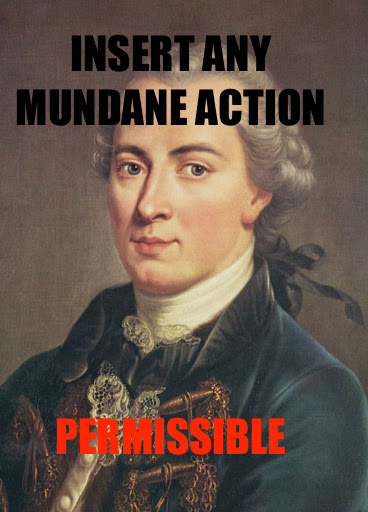
Our moral advice here stems from the fact that, in accordance with Kantian morality, many actions are indeed permissible (and moral). This is because whether or not an action is permissible hinges on the maxim itself and its universalizability, rather than the consequences of that action. This is to say that if the maxim (or the framing of the action, i.e. “I will do ‘x’ in order to ‘y’) is found to be universalizable (resulting in no contradictions at all) according to sound logical reasoning, then the action is entirely permissible and moral. 

For the first prompt, our conclusion that wishing death upon a sitting president is justified (or at least a permissible thing to do) was reached by following this reasoning process. Even if someone were to disagree with this conclusion, we found it to be universalizable under Kantian morality because it does not result in a contradiction.

This same line of reasoning holds true for the second situation as well; no contradiction is created by one willing this action (being upfront with romantic feelings for a former teacher) to be universalized. Again, one might stand in stark disagreement with this action, but because it does not strictly result in a contradiction given the maxim that we have established, it is entirely permissible. 

To reiterate, the most important aspect to note in understanding our Kantian advice for these two situations is that Kant’s philosophy has nothing to do with the consequences of actions, but rather their universalizability.

Trump and LGBTQ+ Rights: A Kantian Perspective

The first prompt we chose asks whether individuals are justified in wishing death upon Trump.

Kant states, “there is only a single categorical imperative and it is this: act only in accordance with that maxim through which you can at the same time will that it become a universal law” (AK 4: 421). A maxim is a general rule that contains an action and a purpose. What this quote means is that it is necessary to look at the rationality of the conduct rather than its morality. This quote also mentions universal laws which are governing rules which humans have to follow. In order to test for universalizability and see if something is a universal law, there are a couple of steps in a procedure that one must follow. The first step is to formulate a maxim. The next step is to universalize the maxim. Next, we have to evaluate the possibility. A maxim that is not possible would result in an impossible world. Lastly, we have to come to a conclusion whether it is a universal law or not. If it is the latter, the action will be considered a moral duty.

In this example, the prompt is asking whether or not individuals are justified in wishing death upon Donald Trump. To see if wishing death upon Donald Trump can be a universal law, let’s do the universal law test. The maxim would be “I will wish death upon Donald Trump because I disagree with his opinions”. To universalize it, the maxim would change to “everyone will wish death upon Donald Trump because we disagree with his opinions”. Next, it has to be considered if it is possible or not. Everyone wishing death upon Donald Trump is impossible and is not practical. Not only do many people agree with his political views and the way he governs but if all people were to justify murder through difference in opinion then there would be anarchy world wide. According to this scenario there will never be a point where everyone wishes death upon Donald Trump, therefore this scenario is not universalizable. Furthermore, within the scenario concerning if killing Trump or his death is justifiable, the scenario maxim leads to an impossible world; one where a contradiction takes place. According to Kantian philosophy since this world is not possible ( a world where everyone kills due to disagreements or everyone disagrees with Trump), it is not considered a universal law, and instead the moral duty of NOT wishing death upon Donald Trump arises.

According to Kant and his Humanity law concerning moral duties it would be unjustifiable to wish death upon Trump for it contradicts his Humanity law. Kant defines the humanity law as, “the human being, and in general every rational being, exists as end in itself, not merely a means to the discretionary use of this or that will, but in all its actions, those directed toward itself as well as those directed toward other rational beings, it must always at the same time be considered as an end” [Ak 4:428]. Kant’s humanity law can be compared to the Golden rule and can be simplified to not using people to reap consequences/desires for people are goals/ends in themselves. Concerning whether wishing death upon Trump is justifiable or not, if the question concerns justifying killing Trump to reap beneficial political policies then the death of Trump would not be justifiable for Trump is a “rational being”. Within this scenario Trumps death is justified due to said person reaping the benefits of his death but Kant states that no rational being should be used as “merely a means to the discretionary use”. As well, due to Trump’s autonomy he is considered as an “end” instead of as “means”. However, If killing Trump is justified for the greater happiness of the country or one’s self it is still not justifiable for you use the death of Trump to be either “directed towards itself” or “ directed toward other rational beings”. Furthermore, Kant described his humanity law “ground principle” o as “Rational nature exists as an end in itself [Ak 4:429]”. The grounds of his principle clearly states that Kant would find Trump’s death unjustifiable for within this scenario if his death is justified for the sole benefit of the positive consequences that one could reap then Trump is not being treated within his “Rational nature”. No matter what justification towards Trump’s death, if it is based on others or one’s self reaping the benefits of his death, Kant would believe it is unjustifiable for it contradicts his law of humanity.

The second prompt asks whether it is acceptable to end a friendship over a difference in “opinions” – in this case, regarding the value of LGBTQ+ rights in a society. It may be possible for this to be simplified to the question of whether a person should stop being friends with another person due to a difference in opinions.

However, it is not appropriate to reduce this particular conflict to a mere difference of opinion, this is not a debate about abstract economic policy or favorite schmear flavor, but the eligibility of a group of people for basic human rights. Kant’s categorical imperative may actually lead us to unusual conclusions about human rights. Here we address the specific scenario: the poster is struggling to decide whether a friend not supporting LGBTQ+ rights is enough reason to end their friendship.

Based on the categorical imperative, there are three (previously explicated) steps by which we should evaluate whether this action and purpose aim at the good. Kant requires these hypothetical rational agents, which are essential to the structure of his moral philosophy “act as if the maxim of your action were to become through your will a universal law of nature” [Ak4: 421]. The maxim should be articulated as a “I will cut off my friend to express the value of LGBTQ+ rights.” In order for this action to be acceptable to Kant, this maxim cannot be a partial demand, you must act in a manner that all other people can also act.

Next, we should universalize the maxim, and in this imagine a world where all people take the action, namely cutting off friends who do not support the rights of LGBTQ+ people. All people would cut off friendship with people who do not endorse the same values concerning the human rights of LGBTQ+ people. If individuals are cutting people off in order to change the opinion of the friend, this contradicts the humanity law as we are treating those individuals as mere means. Not supporting rights for LGBTQ+ people also might encompass a broad range of beliefs which have varying degrees of exclusivity, and distinguishing between these beliefs if not explicated may result in unwarranted or unreasonable action. This maxim is explicitly about whether the individual values the rights of LGBTQ+ people, and not about the opinions that they hold about LGBTQ+ people in general. Regardless of these consequences or complications, the maxim does appear universalizable and it produces a coherent world in which friend groups are divided based on differences in beliefs. Friendship is a voluntary relationship between two people that is mutually beneficial, thus there is no teleological contradiction with the nature of friendship.

Kant’s formula of humanity suggests that one is never morally justified in using another person’s humanity as a mere means to an end – even if that end is to save your own life. When attempting to apply this to the case at hand, the maxim that is being applied must be considered. If the poster’s maxim was “I will no longer be friends with this person so that they change their minds about LGBTQ+ rights,” they may be using them as a means to achieve an end. In this case, it would seem as though the poster is actively changing their interactions with their friend to achieve the outcome of them changing their mind, which would involve intentionally including their friend in the realization of the end. Even if the poster thinks this will benefit their friend, they are still actively implicating another’s behavior in the production of their desired end, which Kant would say is not morally permissible.

However, if the poster’s maxim was formulated to be something like “I will cut off my friend to express the value of LGBTQ+ rights,” Kant’s answer could be different. In this case, the friend is not being used merely as a means, but is employing their own autonomy to choose how they spend their time and which ideas and arguments they expose themselves to and tolerate. They aren’t using the friend’s humanity as they aren’t expecting any result to come from an action on the part of their friend – instead, they are changing their own actions to attempt to respect and support the autonomy of others to make their own decisions regarding who they marry and how they spend their time. This maxim seems much more universalized, and almost approaches the definition of friendship – the ability to choose to surround yourself with people who you enjoy spending time with and who improve your life. Ultimately, Kant would probably support cutting the friend off if the purpose of the action is narrow and personal enough to remain both universalizable and to respect the autonomy of the friend in question.