Mill’s Utilitarianism In Practice

Overview

Utilitarian Mill defends the idea that “actions are right in proportion as they tend to promote happiness, wrong as they tend to produce the reverse of happiness” (186). This is a subjective rather than an objective consequentialist framework: Mill does not say what the specific objects of happiness and pleasure are, simply that increasing them both in quantity and quality is the goal of morality. Mill thinks that desiring to promote happiness and minimize pain is a sufficient motivation to take good actions, in fact this is the first principle that he thinks we have made the grave error of not previously identifying. Once we have this, all more complex moral questions should fall into place.

One complication that emerges is the distinction between motivation and intention. Mill separates these as such: motivation is the “disposition—bent of character”, and intention is what the agent “wills to do” (196). This initially seems a bit counterintuitive; if someone takes actions that have beneficial consequences for the most number of people, how can their disposition of character still be bent towards immorality? In separating these two we end up with people deserving of their moral desert who have a much smaller sphere of influence than people with a large sphere that act in bad faith because of some secret benefit to themselves.

Utilitarianism has gotten a bad reputation from some naysayers who label utilitarians as heartless, focused on improper ends, and simply asks too much from people. Mill responds to the charge of ‘coldness’ by saying that those who hold to systems of virtue ethics are equally cold to those they feel have not developed their virtue effortfully and doubles down, saying that “in the long run the best proof of a good character is good actions; and [utilitarians] resolutely refuse to consider any mental disposition as good, of which the predominant tendency is to produce bad conduct” (197).

Mill confronts the accusation that utilitarianism sets too high of a standard, his response is that “no system of ethics requires that the sole motive of all we do shall be a feeling of duty,” (195) meaning that most people will have very few occasions to make decisions that have a massive impact on the happiness of society. Mill responds to the most popular objection, which asserts that utilitarianism’s end of ‘pleasure’ is not dignified enough for humans, by introducing a separation between high and low pleasures.

Prompt 1

“My boyfriend wants to follow me and live with me after he graduates from his university, but I’m not sure if I want to be responsible for changing his career trajectory and have him move to a new town. But at the same time I still want to be with him.”

The individual who asked this question left a fair amount of details open for interpretation. They hinge their moral issue on their own potential feelings of responsibility for the situation, which adds an interesting layer to the strictly utilitarian view of the argument. In order to do a purely utilitarian analysis, we would have to know with more certainty about what the poster’s boyfriend is giving up, and heading towards. If he was giving up his dream job, for example, that could have a large effect on the happiness balance required by Mill’s theory. Even if he wants to leave, and they both want to be with each other, he would be significantly reducing his own happiness, which would have to be considered. However, if there is greater potential for long-term happiness accumulation in a different field or place, it could be an easy decision from the utilitarian perspective.

The introduction of weighing the responsibility felt by the poster seems as though it increases the complexity of weighing the decision. For Mill, though, it seems as though this would not be a significant factor. He writes that the greatest happiness principle is designed to produce

existence exempt as far as possible from pain, and as rich as possible in enjoyments, both in point of quantity and quality; the test of quality, and the rule for measuring it against quantity, being the preference felt by those who, in their opportunities of experience, to which must be added their habits of self-consciousness and self-observation, are best furnished with the means of comparison. (Mill section 10)

Importantly, here, he points out that those who are ‘best furnished with the means of comparison,’ and are therefore able to make the most educated decision, should be the ones giving the most input when making decisions. Additionally, he emphasizes the importance of considering both quality and quantity of happiness. In this case, the poster’s boyfriend is considering reducing his quantity of happiness (temporarily, at least, if he has to find a new job or career) in exchange for an increase in the quality by getting to continue his relationship. Ultimately, if the poster is planning to move away regardless of his decision, the boyfriend is going to lose either his career or his girlfriend, so it seems as though it is up to him to weigh those out and decide which would reduce his happiness the least from the utilitarian perspective. However, the poster has an equal right to do that equation for herself – if she would be materially less happy if her boyfriend moved with her, she should express that.

Applying Mill’s Greatest Happiness Principle here does not produce a completely satisfying answer, because it ultimately dictates that the only people who can really judge the situation are those whose happiness is most directly affected by it. However, applying the utilitarian logic of maximizing happiness more generally does show that there will be potential decreases in happiness regardless of what happens, which should reduce the responsibility that the poster feels towards her boyfriend making the choice to come with her.

Prompt 2

Should I build a fence and refrain the neighbors from using the pool?

TLDR: The narrator had just moved into a pool and has a pool in their backyard. The neighbors had told the narrator that sometimes the old owner would let them use the pool, however the narrator said that she was uncomfortable with that and that they can use it occasionally. However, the neighbors’ kids abused the privilege all summer and she is now planning to put up a fence. The fence is within regulation and on the property line, however the neighbor suggested that she was depriving them of the pool and that she should put a gate between the yards, so it would be easier for the kids to come to her house.

In Mill’s perspective, he would be in favor of not putting up the fence. The owner at hand would be considered the agent. Mill says that “the happiness which forms the utilitarian standard of what is right in conduct, is not the agent’s own happiness, but that of all concerned. As between his own happiness and that of others, utilitarianism requires him to be as strictly impartial as a disinterested and benevolent spectator” (Mill 194). In other words, the agent’s happiness should not be prioritized, but instead their happiness should be alongside the happiness of the neighbors. It should be equal. When analyzing this prompt, we can go about it in two ways depending on whose happiness outweighs the other. In my opinion, Mill would say that the happiness of the kids and the neighbors is the maximization of happiness and therefore that outweighs the happiness of the owner.

Additionally, Mill argues for a distribution of wealth to those who are more disadvantaged than you are. For example, say you had $17 in your wallet. Mill believes that you are much richer than most people and therefore must give up those $17. For this specific prompt, Mill would see the pool in the same way as the money. This would mean that the owner would have to share the pool with the less fortunate (the neighbors). All things considered, Mill would be against the owner’s plan of refraining the neighbors from using the pool. However, the neighbors did point out the idea of putting a gate in the fence so that the kids can come though it to use the pool. I believe that this would be the best idea and Mill would agree as this gives the agent some happiness while also sharing her wealth and giving happiness to the neighbors.

Synthesis

Overall, Mill has a utilitarianism view of the world. Utilitarianism’s primary focus is structured for the greater good for the most people. Within Mill’s view it is not the greater good but the amount of happiness for the most people that constitutes a morally significant action. Mill specifically believes that the relevant measure rather than greater good is the amount of happiness. Mill subsequently believes and judges one’s moral significance through the total amount of happiness achieved through an action. Concerning the first prompt, Mill would believe the boyfriend should stay in the relationships as it would keep the happiness level the same and any other change would decrease it. Concerning the second prompt and whether the neighbors should use the pool Mill would believe it would be morally right for the owner to allow the neighbors to use their pool as it leads to a majority of the people being happy. Overall, Mill judges one’s actions on their affective happiness, so Mill would say for the boyfriend to stay in his relationship on the first prompt and in favor for the neighbors to use the pool in the second.
Mundane Morality: Sarah Buss on Respect

The first prompt we are discussing is from the Reddit post “WIBTA for not apologizing to smothering in-laws?” This post is written by a bride and discusses how she is fighting with her in-laws. She writes that, because her in-laws have said and done multiple extremely rude things, she sprayed her mother-in-law with water from a hose and is wondering if she should apologize or not.

Buss takes a Kantian deontological approach to moral significance. She believes moral significance is derived from manners and their use within; appearance, cultural relativism, and being agreeable. Concerning this specific reddit post Buss would believe, through manners and appearance, that the bride is in the wrong and should apologize to her in-laws even if they were rude first. Buss fundamentally believes that, “To treat people with respect is to act in a way that acknowledges their dignity, and to act this way because they have dignity (802).

Even though the in-laws might have been rude first and were not being polite or respectful, the bride is further increasing the disrespect by escalating the conflict (spraying with a hose). She is also not acknowledging her in laws with their innate “dignity,” choosing to see their actions in the worst light possible instead of giving them the benefit of the doubt. Furthermore, Buss wrote previously that “The point of good manners is to create a certain appearance, to show others that one does not care overly much for one’s own dear self (799)”. The bride did not apologize by adhering to manners to “create a certain appearance”, the bride is then exhibiting the opposite of “not car[ing] overly much for one’s dear self” which reveals a more self-interested nature rather than one of benevolence, which Buss believes is central to manners and appearance. Since the bride did not apologize to her in-laws the bride is not only not treating her in laws with their innate respect/dignity but is revealing she cares more for her wants then their wants. The bride’s actions exhibit how her manners do not give her a good appearance and are therefore are morally wrong.

The second prompt is focused on the Reddit post, “AITA for telling my friend that I don’t care about her sexual orientation”? This post deals with an individual that has come out as lesbian to their friend group. This individual is lesbian and has conversations with the author of the post in which she tells them to explore their sexuality and has asked, what the author believes are inappropriate questions. The author told her that she does not care about her sexual orientation, which hurts the individual who then accused the poster of being a “closet homophobe”.

In order to determine if the person is morally right to say that they don’t care about the individual’s sexual orientation, we will use Sarah Buss’ perspective of Kantian deontology with a focus on manners and their moral significance. Buss believes that in order to be polite, one must treat the other as an object of respect. To make her argument that manners are morally significant, Buss states that manners are different from morality as they encourage people to make themselves agreeable which acknowledges one’s dignity. She says that “people have a basic moral obligation to make themselves agreeable to others,” and that “making oneself agreeable to others is not only an end in itself; it is also, and more importantly, a means to treating them with respect” (798).

In relating these quotes to the example, Buss would say that when the author of the prompt says they don’t care about the individual’s sexual orientation, it is a way of them not making themselves agreeable to others, thus is morally wrong. In addition, Buss says that “to treat someone ‘‘with respect’’ is to treat [them] in a way that acknowledges [their] intrinsic value, or ‘‘dignity.’” (797). By saying that you don’t care about another person’s sexual orientation, you are not showing them respect, as well as not acknowledging their dignity. Instead, it is making it seem as if you do not value the person. That the person’s feelings and thoughts are not valid; that they don’t even matter in the first place. To make one agreeable is to show consideration, which would make people less inclined to harm others, care more about people’s well-beings, and be conditioned to regard people with the dignity they deserve (800).

Although the poster is well within their rights to not, for example, attend a political protest in support of gay marriage, they are actively disparaging their friend’s intrinsic choices and preferences unnecessarily by verbally attacking them. The lack of agreeability that the author seems to have would result in the opposite of this and would lead to an immoral life, one that is severely impoverished. The author in this scenario needs think more about how their actions affect those around them – even if the issue is not significant to the poster, it clearly means a lot to their friend.

Summary

Often, the most significant challenge with moral philosophy comes from the fact that there are usually multiple individuals involved in any issue, each with their own moral preferences, predispositions, goals and worries. In both of these cases, it’s possible to see both sides of the argument. For the first, it’s possible that the poster had been experiencing years of mentally exhausting comments from their in-laws, and out of pure, instinctual frustration they pointed their hose in their mother-in-laws direction. This action still isn’t morally admirable, but adding different levels of context can help some justify different moral situations. The beauty (or downfall, for some) of deontological ethics comes from its relative certainty on some issues – although there are many things that are probably still immoral that are not “banned” by its standards, it takes clear and definite stances on some issues.

As Amy Olberding has previously shown us, a significant amount of “moral” action occurs in the arena of everyday life – the small moments between people that, while potentially insignificant on their own, build up to define the way people feel about each other and morality in general. Her argument is designed to emphasize the importance of manners – by mindfully acting in a way that signals to others that you care about their dignity enough to be polite, humans send each other constantly reinforcing messages that they should each continue to care about each other.

Buss reinforces this argument, but takes the opposite approach by relying on Kantian arguments about the importance of treating rational beings as ends themselves and with respect (as they are an equally autonomous being). For her, the respect that manners convey is the exact same as the respect that morality in general creates – because of this, being ill mannered towards someone is as bad as being more actively immoral. In the cases discussed, there is no one right answer. However, in both cases, they require the poster to put aside their pride and choose to directly express their respect for others. They don’t have to cave in and take their side, but they have an obligation to each other, and themselves, to treat the people around them with as much respect as possible.

Trump and LGBTQ+ Rights: A Kantian Perspective

The first prompt we chose asks whether individuals are justified in wishing death upon Trump.

Kant states, “there is only a single categorical imperative and it is this: act only in accordance with that maxim through which you can at the same time will that it become a universal law” (AK 4: 421). A maxim is a general rule that contains an action and a purpose. What this quote means is that it is necessary to look at the rationality of the conduct rather than its morality. This quote also mentions universal laws which are governing rules which humans have to follow. In order to test for universalizability and see if something is a universal law, there are a couple of steps in a procedure that one must follow. The first step is to formulate a maxim. The next step is to universalize the maxim. Next, we have to evaluate the possibility. A maxim that is not possible would result in an impossible world. Lastly, we have to come to a conclusion whether it is a universal law or not. If it is the latter, the action will be considered a moral duty.

In this example, the prompt is asking whether or not individuals are justified in wishing death upon Donald Trump. To see if wishing death upon Donald Trump can be a universal law, let’s do the universal law test. The maxim would be “I will wish death upon Donald Trump because I disagree with his opinions”. To universalize it, the maxim would change to “everyone will wish death upon Donald Trump because we disagree with his opinions”. Next, it has to be considered if it is possible or not. Everyone wishing death upon Donald Trump is impossible and is not practical. Not only do many people agree with his political views and the way he governs but if all people were to justify murder through difference in opinion then there would be anarchy world wide. According to this scenario there will never be a point where everyone wishes death upon Donald Trump, therefore this scenario is not universalizable. Furthermore, within the scenario concerning if killing Trump or his death is justifiable, the scenario maxim leads to an impossible world; one where a contradiction takes place. According to Kantian philosophy since this world is not possible ( a world where everyone kills due to disagreements or everyone disagrees with Trump), it is not considered a universal law, and instead the moral duty of NOT wishing death upon Donald Trump arises.

According to Kant and his Humanity law concerning moral duties it would be unjustifiable to wish death upon Trump for it contradicts his Humanity law. Kant defines the humanity law as, “the human being, and in general every rational being, exists as end in itself, not merely a means to the discretionary use of this or that will, but in all its actions, those directed toward itself as well as those directed toward other rational beings, it must always at the same time be considered as an end” [Ak 4:428]. Kant’s humanity law can be compared to the Golden rule and can be simplified to not using people to reap consequences/desires for people are goals/ends in themselves. Concerning whether wishing death upon Trump is justifiable or not, if the question concerns justifying killing Trump to reap beneficial political policies then the death of Trump would not be justifiable for Trump is a “rational being”. Within this scenario Trumps death is justified due to said person reaping the benefits of his death but Kant states that no rational being should be used as “merely a means to the discretionary use”. As well, due to Trump’s autonomy he is considered as an “end” instead of as “means”. However, If killing Trump is justified for the greater happiness of the country or one’s self it is still not justifiable for you use the death of Trump to be either “directed towards itself” or “ directed toward other rational beings”. Furthermore, Kant described his humanity law “ground principle” o as “Rational nature exists as an end in itself [Ak 4:429]”. The grounds of his principle clearly states that Kant would find Trump’s death unjustifiable for within this scenario if his death is justified for the sole benefit of the positive consequences that one could reap then Trump is not being treated within his “Rational nature”. No matter what justification towards Trump’s death, if it is based on others or one’s self reaping the benefits of his death, Kant would believe it is unjustifiable for it contradicts his law of humanity.

The second prompt asks whether it is acceptable to end a friendship over a difference in “opinions” – in this case, regarding the value of LGBTQ+ rights in a society. It may be possible for this to be simplified to the question of whether a person should stop being friends with another person due to a difference in opinions.

However, it is not appropriate to reduce this particular conflict to a mere difference of opinion, this is not a debate about abstract economic policy or favorite schmear flavor, but the eligibility of a group of people for basic human rights. Kant’s categorical imperative may actually lead us to unusual conclusions about human rights. Here we address the specific scenario: the poster is struggling to decide whether a friend not supporting LGBTQ+ rights is enough reason to end their friendship.

Based on the categorical imperative, there are three (previously explicated) steps by which we should evaluate whether this action and purpose aim at the good. Kant requires these hypothetical rational agents, which are essential to the structure of his moral philosophy “act as if the maxim of your action were to become through your will a universal law of nature” [Ak4: 421]. The maxim should be articulated as a “I will cut off my friend to express the value of LGBTQ+ rights.” In order for this action to be acceptable to Kant, this maxim cannot be a partial demand, you must act in a manner that all other people can also act.

Next, we should universalize the maxim, and in this imagine a world where all people take the action, namely cutting off friends who do not support the rights of LGBTQ+ people. All people would cut off friendship with people who do not endorse the same values concerning the human rights of LGBTQ+ people. If individuals are cutting people off in order to change the opinion of the friend, this contradicts the humanity law as we are treating those individuals as mere means. Not supporting rights for LGBTQ+ people also might encompass a broad range of beliefs which have varying degrees of exclusivity, and distinguishing between these beliefs if not explicated may result in unwarranted or unreasonable action. This maxim is explicitly about whether the individual values the rights of LGBTQ+ people, and not about the opinions that they hold about LGBTQ+ people in general. Regardless of these consequences or complications, the maxim does appear universalizable and it produces a coherent world in which friend groups are divided based on differences in beliefs. Friendship is a voluntary relationship between two people that is mutually beneficial, thus there is no teleological contradiction with the nature of friendship.

Kant’s formula of humanity suggests that one is never morally justified in using another person’s humanity as a mere means to an end – even if that end is to save your own life. When attempting to apply this to the case at hand, the maxim that is being applied must be considered. If the poster’s maxim was “I will no longer be friends with this person so that they change their minds about LGBTQ+ rights,” they may be using them as a means to achieve an end. In this case, it would seem as though the poster is actively changing their interactions with their friend to achieve the outcome of them changing their mind, which would involve intentionally including their friend in the realization of the end. Even if the poster thinks this will benefit their friend, they are still actively implicating another’s behavior in the production of their desired end, which Kant would say is not morally permissible.

However, if the poster’s maxim was formulated to be something like “I will cut off my friend to express the value of LGBTQ+ rights,” Kant’s answer could be different. In this case, the friend is not being used merely as a means, but is employing their own autonomy to choose how they spend their time and which ideas and arguments they expose themselves to and tolerate. They aren’t using the friend’s humanity as they aren’t expecting any result to come from an action on the part of their friend – instead, they are changing their own actions to attempt to respect and support the autonomy of others to make their own decisions regarding who they marry and how they spend their time. This maxim seems much more universalized, and almost approaches the definition of friendship – the ability to choose to surround yourself with people who you enjoy spending time with and who improve your life. Ultimately, Kant would probably support cutting the friend off if the purpose of the action is narrow and personal enough to remain both universalizable and to respect the autonomy of the friend in question.

Mengzi’s Human Nature and The Petty Life

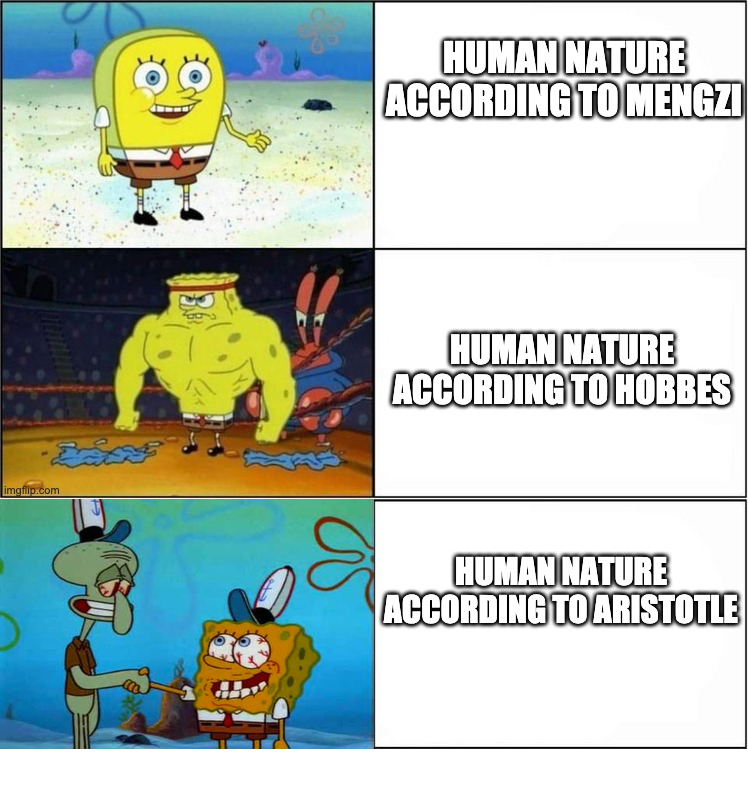
Mengzi makes it clear that, in his eyes, all humans are born with the mental tools that they need to live a morally good life. He writes that humans have a set of tools (‘hearts’) such as compassion and approval, which when internally practiced and followed produce the ‘sprout’ of virtues (2A6). “Benevolence, righteousness, propriety, and wisdom are not welded to us externally. We inherently have them” (6A6). However, while we have the hearts that are necessary to produce good virtue, he makes it clear that humans have a responsibility to use the tools they have been given. “People having these sprouts is like their having four limbs. To have these four sprouts but to say of oneself that one is unable to be virtuous is to steal from oneself” (2A6), he says.

In this post, we will consider two different situations that challenge Mengzi’s conception of human nature and virtues.

1. I have a friend who is part of the LDS church and does not believe in gay marriage (I definitely do). We have been friends since we were in kindergarten, and of course at that time we didn’t think about these differences. Should I not be friends with him since he doesn’t value LGBTQ+ rights?

From our contemporary moral standpoint, it is clear that the homophobic friend is being immorally discriminatory. We think Mengzi would agree, as it seems that they are choosing not to use their heart of compassion and relying too much on their heart of disdain. Mengzi also makes multiple mentions to the slightly intuitive nature of intrinsic morality. He suggests that someone not burying their parents would feel a visceral moral guilt (6A15), and that even when individuals choose to ‘chop down the trees’ of their natural goodness, they have not destroyed the nature of their goodness (6A8). Instead of the friend’s hearts producing virtuous sprouts, they are hurting the people around them and choosing to ignore their moral potential. Mengzi writes that human nature is like water naturally flowing downwards, but cautions that water can still move uphill with force or intervention. Even if there are problems, the friend can still make choices to return to their virtuous nature, but is choosing not to and instead continues to push the water uphill. He also mentions that a significant part of acting virtuously is taking the natural feelings of care that we have for those we love and extending it to everyone, near and far (1A7). This friend is doing the opposite, insulating themselves from others which Mengzi suggests would actually hurt his ability to provide for himself and his family.

In response, one might point out that Mengzi makes multiple references to the impact that environment has on whether someone is acting virtuously or not. He writes that “in years of plenty, most young men are gentle, in years of poverty, most young men are cruel” (6A7), and uses the metaphor of the same seeds in different soil and water conditions to highlight the importance of one’s surroundings on their hearts. A good modern example of this could be Edmund Kemper or David Berkowitz – two serial killers that are obviously not virtuous people, but looking into their history, we can infer the factors that stunted their emotional growth and capability to develop empathy. They were both horribly abused physically, sexually, and emotionally by their mothers, which definitely contributed to their lack of empathy. This impacted the way they treated women, because their growth was stunted and they were. Mengzi would claim that even given this, it in no way justified their actions. I will expand more on why he thinks this in a minute.

Growing up as a member of the Mormon church, surrounded by a community that largely holds homophobic beliefs, there is cause to believe this person has grown up thinking that their beliefs were not only moral, but that believing anything contrary would in fact be the immoral decision. Jules, who grew up in Salt Lake City, Utah, took the city bus past the temple and the mall owned by the Mormon church every day. They have seen firsthand how the ways in which someone is raised can impact their worldview and perspective on others. As part of the LGBT community they experienced great discrimination from many members of the church in their youth, and late into my teen years. Mengzi would probably argue that constant indoctrination from a young age is what influenced these people to discriminate against the community when they saw that they were not living the life that they viewed as ethical or good. Interfering with someone’s ability to live the good life can be derived from a lack of empathy, which comes from a lack of understanding. From a very young age, these people learn many lessons about how homosexuality and sexuality in general are a sin. This means that it is likely that this person’s childhood friend is exhibiting symptoms of their upbringing. The friend believes they are helping the writer achieve benevolence and live a virtuous life, but his intentions are guided by naivety.

Mengzi writes that “if one must violate and rob the willow tree in order to make it into cups and bowls -must you also violate and rob people in order to make them benevolent and righteous” (6A2)? Jules has seen mormon friends change their opinion after exposure to new ideas, and even leave the church itself when they realized that the institution of the mormon church was doing more harm than good. This further supports the argument that, ultimately, the poster is justified in feeling upset with their friend, because they are no longer a child and there are limitless opportunities and resources one can use for education today.

However, despite Mengzi’s acknowledgement of the impact surroundings can have, he still places the responsibility squarely on the individual to grow and continually apply their tools to be, and remain, virtuous. “The office of the heart is to reflect. If it reflects, then it will get virtue. If it does not reflect, then it will not” (6A15). Even virtuous people need to be constantly reflecting on their place in the world, and this friend is not excluded from that responsibility. Ultimately, the poster would definitely be justified in ending the friendship from Mengzi’s moral perspective. Although this is an example of a lack of personal introspection and growth on a smaller scale, tendencies like that can have a very significant impact when they are displayed by those in power.

2. Are individuals justified in wishing death upon Donald Trump?

On October 2, 2020, Donald Trump’s lack of consideration for others caught up to him, and he contracted the Coronavirus. Examining Donald Trump’s upbringing can better help us understand how he has failed to develop moral virtues by Mengzi’s definitions. Trump grew up in New York and made his money from real estate his father gave him (“a small loan of a million dollars”) to start off his life. One million dollars is a significant amount of money, especially considering that in 2020, 40% of Americans couldn’t afford a 400 dollar emergency (ABC News). However, despite being set up so well, he continually made poor business decisions and relied on his financial status to hire lawyers and send people hush money to cover up his failings. Mengzi states that “those who follow their greater part become great humans. Those who follow their petty part become petty humans” (6A15). He is not being good when he does not even know what the “Common man” wants and thus is a faulty leader and following the pettiness that lies in his heart.

Trump also seems to be so far past cultivating his hearts that he no longer resembles Mengzi’s ideas about human nature. Mengzi believes that humans have all the tools they need to be virtuous, but understands that circumstances can affect how easy it is for someone to flourish. “Although there are some differences, these are due to the richness of the soil, and to the unevenness in the rain and inhuman effort” (6A7 149). However, Trump is not simply the victim of bad circumstances. He has continually chosen, when given the opportunity, to do what is best for him, even at the cost of others. In 6A7, Mengzi says “in years of plenty, most young men are gentle; in years of poverty, most young men are cruel,” and yet we see Trump continually living years of plenty and remaining cruel which allows me to believe he is closer to an animal than a human (148).

Death is the true equalizer in the human experience. Not only does it happen to all humans but we know that it will happen to all humans. We think that Donald Trump is a despicable man and leader, who has torn families apart that were, and still are, looking for a better life. As a result of his mishandling of the global pandemic, 205,000 people have died. The only thing that matters to Trump is his own life. Because he has actively chosen to ignore his human nature at every point in his life, we think that individuals would not be morally wrong in wishing for his death.