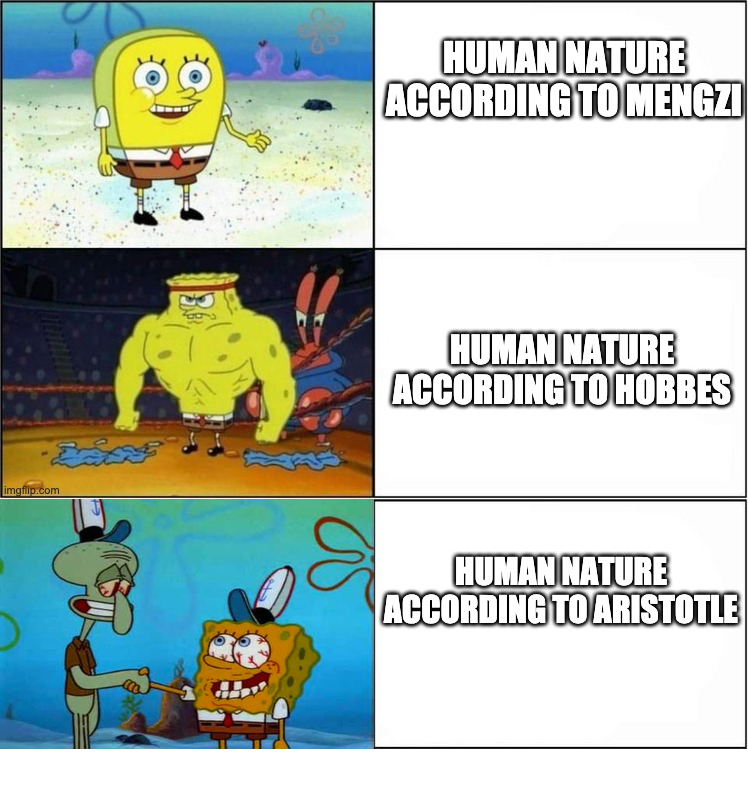
Mengzi makes it clear that, in his eyes, all humans are born with the mental tools that they need to live a morally good life. He writes that humans have a set of tools (‘hearts’) such as compassion and approval, which when internally practiced and followed produce the ‘sprout’ of virtues (2A6). “Benevolence, righteousness, propriety, and wisdom are not welded to us externally. We inherently have them” (6A6). However, while we have the hearts that are necessary to produce good virtue, he makes it clear that humans have a responsibility to use the tools they have been given. “People having these sprouts is like their having four limbs. To have these four sprouts but to say of oneself that one is unable to be virtuous is to steal from oneself” (2A6), he says.
In this post, we will consider two different situations that challenge Mengzi’s conception of human nature and virtues.
1. I have a friend who is part of the LDS church and does not believe in gay marriage (I definitely do). We have been friends since we were in kindergarten, and of course at that time we didn’t think about these differences. Should I not be friends with him since he doesn’t value LGBTQ+ rights?
From our contemporary moral standpoint, it is clear that the homophobic friend is being immorally discriminatory. We think Mengzi would agree, as it seems that they are choosing not to use their heart of compassion and relying too much on their heart of disdain. Mengzi also makes multiple mentions to the slightly intuitive nature of intrinsic morality. He suggests that someone not burying their parents would feel a visceral moral guilt (6A15), and that even when individuals choose to ‘chop down the trees’ of their natural goodness, they have not destroyed the nature of their goodness (6A8). Instead of the friend’s hearts producing virtuous sprouts, they are hurting the people around them and choosing to ignore their moral potential. Mengzi writes that human nature is like water naturally flowing downwards, but cautions that water can still move uphill with force or intervention. Even if there are problems, the friend can still make choices to return to their virtuous nature, but is choosing not to and instead continues to push the water uphill. He also mentions that a significant part of acting virtuously is taking the natural feelings of care that we have for those we love and extending it to everyone, near and far (1A7). This friend is doing the opposite, insulating themselves from others which Mengzi suggests would actually hurt his ability to provide for himself and his family.
In response, one might point out that Mengzi makes multiple references to the impact that environment has on whether someone is acting virtuously or not. He writes that “in years of plenty, most young men are gentle, in years of poverty, most young men are cruel” (6A7), and uses the metaphor of the same seeds in different soil and water conditions to highlight the importance of one’s surroundings on their hearts. A good modern example of this could be Edmund Kemper or David Berkowitz – two serial killers that are obviously not virtuous people, but looking into their history, we can infer the factors that stunted their emotional growth and capability to develop empathy. They were both horribly abused physically, sexually, and emotionally by their mothers, which definitely contributed to their lack of empathy. This impacted the way they treated women, because their growth was stunted and they were. Mengzi would claim that even given this, it in no way justified their actions. I will expand more on why he thinks this in a minute.
Growing up as a member of the Mormon church, surrounded by a community that largely holds homophobic beliefs, there is cause to believe this person has grown up thinking that their beliefs were not only moral, but that believing anything contrary would in fact be the immoral decision. Jules, who grew up in Salt Lake City, Utah, took the city bus past the temple and the mall owned by the Mormon church every day. They have seen firsthand how the ways in which someone is raised can impact their worldview and perspective on others. As part of the LGBT community they experienced great discrimination from many members of the church in their youth, and late into my teen years. Mengzi would probably argue that constant indoctrination from a young age is what influenced these people to discriminate against the community when they saw that they were not living the life that they viewed as ethical or good. Interfering with someone’s ability to live the good life can be derived from a lack of empathy, which comes from a lack of understanding. From a very young age, these people learn many lessons about how homosexuality and sexuality in general are a sin. This means that it is likely that this person’s childhood friend is exhibiting symptoms of their upbringing. The friend believes they are helping the writer achieve benevolence and live a virtuous life, but his intentions are guided by naivety.
Mengzi writes that “if one must violate and rob the willow tree in order to make it into cups and bowls -must you also violate and rob people in order to make them benevolent and righteous” (6A2)? Jules has seen mormon friends change their opinion after exposure to new ideas, and even leave the church itself when they realized that the institution of the mormon church was doing more harm than good. This further supports the argument that, ultimately, the poster is justified in feeling upset with their friend, because they are no longer a child and there are limitless opportunities and resources one can use for education today.
However, despite Mengzi’s acknowledgement of the impact surroundings can have, he still places the responsibility squarely on the individual to grow and continually apply their tools to be, and remain, virtuous. “The office of the heart is to reflect. If it reflects, then it will get virtue. If it does not reflect, then it will not” (6A15). Even virtuous people need to be constantly reflecting on their place in the world, and this friend is not excluded from that responsibility. Ultimately, the poster would definitely be justified in ending the friendship from Mengzi’s moral perspective. Although this is an example of a lack of personal introspection and growth on a smaller scale, tendencies like that can have a very significant impact when they are displayed by those in power.
2. Are individuals justified in wishing death upon Donald Trump?
On October 2, 2020, Donald Trump’s lack of consideration for others caught up to him, and he contracted the Coronavirus. Examining Donald Trump’s upbringing can better help us understand how he has failed to develop moral virtues by Mengzi’s definitions. Trump grew up in New York and made his money from real estate his father gave him (“a small loan of a million dollars”) to start off his life. One million dollars is a significant amount of money, especially considering that in 2020, 40% of Americans couldn’t afford a 400 dollar emergency (ABC News). However, despite being set up so well, he continually made poor business decisions and relied on his financial status to hire lawyers and send people hush money to cover up his failings. Mengzi states that “those who follow their greater part become great humans. Those who follow their petty part become petty humans” (6A15). He is not being good when he does not even know what the “Common man” wants and thus is a faulty leader and following the pettiness that lies in his heart.
Trump also seems to be so far past cultivating his hearts that he no longer resembles Mengzi’s ideas about human nature. Mengzi believes that humans have all the tools they need to be virtuous, but understands that circumstances can affect how easy it is for someone to flourish. “Although there are some differences, these are due to the richness of the soil, and to the unevenness in the rain and inhuman effort” (6A7 149). However, Trump is not simply the victim of bad circumstances. He has continually chosen, when given the opportunity, to do what is best for him, even at the cost of others. In 6A7, Mengzi says “in years of plenty, most young men are gentle; in years of poverty, most young men are cruel,” and yet we see Trump continually living years of plenty and remaining cruel which allows me to believe he is closer to an animal than a human (148).
Death is the true equalizer in the human experience. Not only does it happen to all humans but we know that it will happen to all humans. We think that Donald Trump is a despicable man and leader, who has torn families apart that were, and still are, looking for a better life. As a result of his mishandling of the global pandemic, 205,000 people have died. The only thing that matters to Trump is his own life. Because he has actively chosen to ignore his human nature at every point in his life, we think that individuals would not be morally wrong in wishing for his death.