Mill’s Utilitarianism In Practice

Overview

Utilitarian Mill defends the idea that “actions are right in proportion as they tend to promote happiness, wrong as they tend to produce the reverse of happiness” (186). This is a subjective rather than an objective consequentialist framework: Mill does not say what the specific objects of happiness and pleasure are, simply that increasing them both in quantity and quality is the goal of morality. Mill thinks that desiring to promote happiness and minimize pain is a sufficient motivation to take good actions, in fact this is the first principle that he thinks we have made the grave error of not previously identifying. Once we have this, all more complex moral questions should fall into place.

One complication that emerges is the distinction between motivation and intention. Mill separates these as such: motivation is the “disposition—bent of character”, and intention is what the agent “wills to do” (196). This initially seems a bit counterintuitive; if someone takes actions that have beneficial consequences for the most number of people, how can their disposition of character still be bent towards immorality? In separating these two we end up with people deserving of their moral desert who have a much smaller sphere of influence than people with a large sphere that act in bad faith because of some secret benefit to themselves.

Utilitarianism has gotten a bad reputation from some naysayers who label utilitarians as heartless, focused on improper ends, and simply asks too much from people. Mill responds to the charge of ‘coldness’ by saying that those who hold to systems of virtue ethics are equally cold to those they feel have not developed their virtue effortfully and doubles down, saying that “in the long run the best proof of a good character is good actions; and [utilitarians] resolutely refuse to consider any mental disposition as good, of which the predominant tendency is to produce bad conduct” (197).

Mill confronts the accusation that utilitarianism sets too high of a standard, his response is that “no system of ethics requires that the sole motive of all we do shall be a feeling of duty,” (195) meaning that most people will have very few occasions to make decisions that have a massive impact on the happiness of society. Mill responds to the most popular objection, which asserts that utilitarianism’s end of ‘pleasure’ is not dignified enough for humans, by introducing a separation between high and low pleasures.

Prompt 1

“My boyfriend wants to follow me and live with me after he graduates from his university, but I’m not sure if I want to be responsible for changing his career trajectory and have him move to a new town. But at the same time I still want to be with him.”

The individual who asked this question left a fair amount of details open for interpretation. They hinge their moral issue on their own potential feelings of responsibility for the situation, which adds an interesting layer to the strictly utilitarian view of the argument. In order to do a purely utilitarian analysis, we would have to know with more certainty about what the poster’s boyfriend is giving up, and heading towards. If he was giving up his dream job, for example, that could have a large effect on the happiness balance required by Mill’s theory. Even if he wants to leave, and they both want to be with each other, he would be significantly reducing his own happiness, which would have to be considered. However, if there is greater potential for long-term happiness accumulation in a different field or place, it could be an easy decision from the utilitarian perspective.

The introduction of weighing the responsibility felt by the poster seems as though it increases the complexity of weighing the decision. For Mill, though, it seems as though this would not be a significant factor. He writes that the greatest happiness principle is designed to produce

existence exempt as far as possible from pain, and as rich as possible in enjoyments, both in point of quantity and quality; the test of quality, and the rule for measuring it against quantity, being the preference felt by those who, in their opportunities of experience, to which must be added their habits of self-consciousness and self-observation, are best furnished with the means of comparison. (Mill section 10)

Importantly, here, he points out that those who are ‘best furnished with the means of comparison,’ and are therefore able to make the most educated decision, should be the ones giving the most input when making decisions. Additionally, he emphasizes the importance of considering both quality and quantity of happiness. In this case, the poster’s boyfriend is considering reducing his quantity of happiness (temporarily, at least, if he has to find a new job or career) in exchange for an increase in the quality by getting to continue his relationship. Ultimately, if the poster is planning to move away regardless of his decision, the boyfriend is going to lose either his career or his girlfriend, so it seems as though it is up to him to weigh those out and decide which would reduce his happiness the least from the utilitarian perspective. However, the poster has an equal right to do that equation for herself – if she would be materially less happy if her boyfriend moved with her, she should express that.

Applying Mill’s Greatest Happiness Principle here does not produce a completely satisfying answer, because it ultimately dictates that the only people who can really judge the situation are those whose happiness is most directly affected by it. However, applying the utilitarian logic of maximizing happiness more generally does show that there will be potential decreases in happiness regardless of what happens, which should reduce the responsibility that the poster feels towards her boyfriend making the choice to come with her.

Prompt 2

Should I build a fence and refrain the neighbors from using the pool?

TLDR: The narrator had just moved into a pool and has a pool in their backyard. The neighbors had told the narrator that sometimes the old owner would let them use the pool, however the narrator said that she was uncomfortable with that and that they can use it occasionally. However, the neighbors’ kids abused the privilege all summer and she is now planning to put up a fence. The fence is within regulation and on the property line, however the neighbor suggested that she was depriving them of the pool and that she should put a gate between the yards, so it would be easier for the kids to come to her house.

In Mill’s perspective, he would be in favor of not putting up the fence. The owner at hand would be considered the agent. Mill says that “the happiness which forms the utilitarian standard of what is right in conduct, is not the agent’s own happiness, but that of all concerned. As between his own happiness and that of others, utilitarianism requires him to be as strictly impartial as a disinterested and benevolent spectator” (Mill 194). In other words, the agent’s happiness should not be prioritized, but instead their happiness should be alongside the happiness of the neighbors. It should be equal. When analyzing this prompt, we can go about it in two ways depending on whose happiness outweighs the other. In my opinion, Mill would say that the happiness of the kids and the neighbors is the maximization of happiness and therefore that outweighs the happiness of the owner.

Additionally, Mill argues for a distribution of wealth to those who are more disadvantaged than you are. For example, say you had $17 in your wallet. Mill believes that you are much richer than most people and therefore must give up those $17. For this specific prompt, Mill would see the pool in the same way as the money. This would mean that the owner would have to share the pool with the less fortunate (the neighbors). All things considered, Mill would be against the owner’s plan of refraining the neighbors from using the pool. However, the neighbors did point out the idea of putting a gate in the fence so that the kids can come though it to use the pool. I believe that this would be the best idea and Mill would agree as this gives the agent some happiness while also sharing her wealth and giving happiness to the neighbors.

Synthesis

Overall, Mill has a utilitarianism view of the world. Utilitarianism’s primary focus is structured for the greater good for the most people. Within Mill’s view it is not the greater good but the amount of happiness for the most people that constitutes a morally significant action. Mill specifically believes that the relevant measure rather than greater good is the amount of happiness. Mill subsequently believes and judges one’s moral significance through the total amount of happiness achieved through an action. Concerning the first prompt, Mill would believe the boyfriend should stay in the relationships as it would keep the happiness level the same and any other change would decrease it. Concerning the second prompt and whether the neighbors should use the pool Mill would believe it would be morally right for the owner to allow the neighbors to use their pool as it leads to a majority of the people being happy. Overall, Mill judges one’s actions on their affective happiness, so Mill would say for the boyfriend to stay in his relationship on the first prompt and in favor for the neighbors to use the pool in the second.

Milling For Happiness in 2020

With 2020 now nearly complete, our hopes of the COVID-19 pandemic coming to an end by 2021 have been dashed. When faced with the prospect of operating for the 2020-21 school year almost all colleges and universities decided to switch to a virtual learning environment. In itself, this decision made sense; yet, when combined with their decisions to retain their high tuition fees, many students and their guardians started to raise complaints. After all, why should they continue to pay large sums of money for an educational experience that is not what they had signed up for? As a result, the following question is one that now plagues colleges and universities across the world: is it morally justified to keep the tuition fee the same despite college moving to the virtual platform and remote from campus?

As stated above, most would argue that the virtual format is not as conducive to learning as if it were in-person. Moreover, some of us live in homes that are distracting and diminish our learning experience, especially given we no longer have access to a quiet, study space like the library. Therefore, to keep tuition costs the same is contradictory to the product. I believe Mill’s recommendation to this dilemma would be relatively straightforward. How does the school operate in a way in which it recognizes its students and vouches for their progression?

As of right now, students are upset because they feel as though the school is acting as a private entity instead of a collegiate institution governing by and for its students. Moreover, there is a reserve pool of money each school has that they can tap into for emergencies, and if Covid isn’t considered one, then I do not know what is. With that being said, Mill would argue that the school needs to give back to the student by reducing the tuition costs. Obviously, the school should ensure that it does not reduce the costs so much it finds itself in bankruptcy, but a calculated amount that shows appreciation for the students. In turn, the students will be happy, not only because the cost of tuition has decreased, but also because they feel fortunate and proud to be represented by an institution that sincerely cares about and listens to its students. And the school, in response to this good deed, may receive heartwarming feedback from the community thanking them for this decision, which may motivate the school to continue acting accordingly in the future. 

Our world is ever-changing as just as we know that the sun will rise in the morning, we know that it takes time for the global pandemic to decline. Colleges should reduce tuition in a grand way. Thus we, the students, haven’t been cheated out of our money and we can still get the quality education that we all want. Education must prevail and no worldwide pandemic can change or hinder how education can and should be taught. Mill would agree with us as in utilitarianism the many outweigh the few because there are far more students than professors or administrators. Mill would agree that a reduced tuition would “make up” for a semester over the internet.

There are many people who hate Donald Trump. After all, were it not for him and his ever-changing administration, a significant portion of the population in the United States believes that many horrors could have been avoided. For instance, the severity of the COVID-19 pandemic. Or the promotion of racism and white nationalism. And here’s the kicker: the objective perspective would likely prove this claim to be true. After all, nations outside of the United States constantly look upon Trump and his administration with horror. As reality stands, Trump and his administration have influenced the death of hundreds of thousands (and that’s just COVID-19). As such, it comes as no surprise that there are people who would (and do) wish death upon Donald Trump. Only one question remains in their way: is this wishful thinking ethical?

This situation potentially seems complex and nuanced, but is relatively simple, especially from Mill’s standpoint of subjective consequentialism. Regardless of how one truly feels about Donald Trump (whether or not one thinks that he deserves to have death wished upon him), I think that it is very hard to argue that wishing death upon him is truly unethical. This is because, according to subjective consequentialism, the act of wishing death upon a president does not impede anyone else’s happiness; in fact, it may even make a lot of people happy (as in, it might make the person doing the wishing happy). Also, just wishing death upon another person, especially if that wish is kept to oneself, does not harm anyone, even the target of the wish. And if this is, in fact, the case, that wishing death upon Donald Trump makes the wisher happy and also does not make anyone else unhappy at all, then this act is definitely ethical according to Mill’s theory and model of subjective consequentialism. 

Ultimately history will continue and all beings on this planet will eventually be consumed by the sun as we slowly die and all we know is lost. Covid 19 is yet another road bump in the journey that we are taking to that moment in time. Mill would say, because utilitarianism accounts for the majority of people, that because one person would die it doesn’t matter, this instead of wishing death upon him allows him to live in banishment. However because he is responsible for allowing over 250,000 Americans to die because of the pandemic he should be held responsible for all the deaths. History will frown upon Donald Trump, but utilitarianism and Mill’s ideals will live on forever because democracy’s main purpose is to adhere to the will of the majority of people, not the rich with wealth and power.

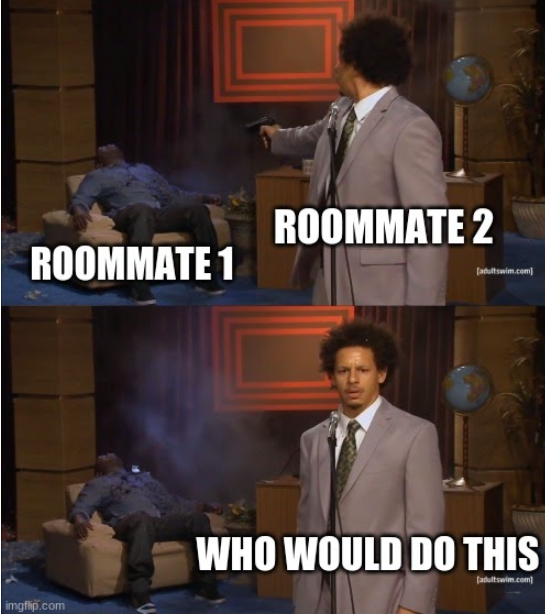
When saving your roommate’s life is FINALLY the “right” decision.

Should I give my dying grandpa pain medicine even though he said he didn’t want it?

TL;DR: A grandfather had stated to his family members previously in his life that he does not want any pain medication if he happens to need it when he is old. As of now, the grandfather is an old man who is suffering from memory loss and tons of pain due to an illness. Although the grandfather had told his family members not to give him pain medication, the time has come as to whether or not he is going to receive some. The family members are worrying about whether or not to give the grandfather the pain medication.

Mill’s answer would be clear in this situation: the family should give the grandpa the pain medication. Being a subjective consequentialist, Mill asserts that a good action is one that brings “the greatest amount of happiness altogether” (189). In this situation, we can assess the happiness in each scenario–if the family gives the grandpa the pain killers, and if they choose not to. If the family did not give the grandpa medicine, the grandpa would still be in pain and this would have repercussive effects on the family and their happiness. The grandpa being in more pain would only increase the stress and discontentment of the family, as well as the doctors who help the grandpa. The grandpa complaining less and being more calm would benefit everyone. The painkillers would increase the grandpa’s current happiness, increase the happiness of the family, and increase the happiness of any doctors helping the grandpa. Some would argue that the grandpa’s happiness would be less because he specifically mentioned not wanting pain killers in the past. But, the grandpa is already losing his memory and currently would be happier if the medication was administered. If the family is still hesitant about the grandpa’s wishes, they could ask him in the state that he is right now about painkillers. Even if the grandpa replies that he does not want medication, the family should still consent to him having it because it would increase their happiness and the happiness of the doctors. Additionally, because Mill defines happiness as “intended pleasure, and the absence of pain”, technically the grandpa’s happiness would be greater, though he does not want the medication (186). Medication would remove pain and increase pleasure in the case of the grandpa, so his opinion on the matter would not be important according to Mill. Overall, Mill would say that the family should give the grandpa pain medication, even if he does not want it.

Should I lie to a murderer at my door to save my roommate’s life?

TL;DR: Two roommates live in a house. Roommate one is in their room and relaxing. Roommate two is in the TV room by the front door. Roommate two hears a knock on the door and to his surprise it is a murderer asking whether or not roommate one is at the house. Roommate two has an opportunity to lie as to the whereabouts of where roommate one is, or he can tell the truth and ultimately end up allowing the murderer to kill roommate one and probably himself (Because no witnesses). Should roommate two lie to save his roommate’s life? 

As Mill represents the subjective consequentialist, concerned with outcomes, and unlike Kant who focuses on the lie, Mill would remain much more focused on the murder about to take place. Essentially, for Mill this becomes a question of saving the most amount of lives because this is connected to happiness; if I lie to the murderer, he/she might kill me as well as my roommate while if I lie, saying my roommates not home, the murderer may leave and we both survive. In this case, Mill would clearly side with lying to immediately protect these individuals’ happiness. As he represents the subjective consequentialist, it’s important to consider the murderers perspective. While the context and motivation for the murder may vary, for this murderer, killing the roommate is bringing them a sort of happiness at the expense of another’s life. While Mozi, the objective consequentialist, maintains ethical standards of contributing to the population or poor, Mill believes the morally right choice is that that produces the overall happiest result to benefit the maximum number of people. Murdering even one person is not producing the happiest outcome for the most number of people. For the above scenario because Mill is the subjective consequentialist and is therefore concerned with the outcomes of the action, Mill would advise the action that brings the greatest subjective happiness to the greatest number of people. Mill represents utilitarianism:


“The creed which accepts as the foundation of morals, Utility, or the Greatest Happiness  Principle, holds that actions are right in  proportion as they tend to promote happiness, wrong as they tend to produce the reverse of happiness. By happiness is intended pleasure, and the absence of pain; by unhappiness, pain, and the privation of pleasure”

Mill 186

Given this quote, it is apparent that Mill would advise the action that promotes happiness and absence of pain. Therefore if roommate #2 lies and says that roommate #1 is not home and this causes the murderer to leave, then both roommates are happy but the murderer is not. If roommate #2 tells the truth and the murderer then comes inside and kills roommate #1 (and possibly #2 as well for being a witness) then both roommates are dead and this is not beneficial to them and only the murderer is happy because this action was only beneficial for the murderer. Therefore, Mill would advise roommate #1 to lie in order to maximize the overall happiness of everyone involved.