Bad Boyfriend

TLDR: The poster’s boyfriend has recently lost his job. Due to this, she is working overtime to support them. She asked him to do the dishes, feed the cat, and a few other housekeeping tasks to cover for the overtime she was spending at work. Not only has he “forgotten” to clean up multiple times, he consistently leaves the house a complete mess. After OP reminded him nicely to start taking a more active role, he was rude to her and suggested he shouldn’t have to clean.

In Nicomachean Ethics, Aristotle begins by positing that the aim of all human action is eudaimonia, roughly translated as ‘flourishing.’ This is his conception of the way that human beings continually grow and evolve throughout their lives, both intellectually and emotionally, to achieve ‘the good life’, an authentically happy and fulfilling experience on Earth. This pursuit never ends, and is made up of many virtuous decisions. According to Aristotle, only those activities that are done with the purpose of increasing flourishing are truly moral.

In Book 2, he fleshes virtue and the way that it creates his conception of morality. He concludes that it is a balance between excess and deficiency, and repeatedly stresses that being virtuous is hard, and something that citizens need to work to learn. Differentiating ourselves from any other animal, however, is our capacity to reason, which allows us to make the decisions that create a virtuous life. “Virtue is a state of character concerned with choice, lying in a mean [between excess and deficiency] … determined by rational principles” (NE 2.6). Beyond this, however, there are many character traits that make up a virtuous person. Traits that are either in excess or deficiency in regards to the situation at hand will be vices, as they fail to rationally discover the ideal mean. For example, courage is the virtuous mean between cowardice and rashness (NE 2.7). Shyness and shamelessness are on either extreme of modesty, and when it comes to money, Aristotle writes that “the mean is liberality, the excess and the defect prodigality [extravagant spending] and meanness” (NE 2.7). Your moral character is built by repeatedly making virtuous decisions, and fully realized virtue means that these decisions become second-nature, as there is no need to even consider the less virtuous options.

Aristotle’s definitions of virtue are often in contrast with other concepts – virtue, for example, is finding the right balance of excess and deficiency. By stressing the importance of human reason, he claims that he does not have to provide specific definitions because all humans will be able to determine what is actually virtuous on their own.

Jack’s Opinion: When it comes to applying this moral theory to the moral problem at hand, the poster is clearly justified in being upset at their boyfriend. First, the boyfriend is clearly not acting virtuously – he is being lazy and unclean (deficient) and rude (excessive) which make his actions clearly immoral. Even though he doesn’t personally seem concerned about the trash and lack of cleanliness, so his temporary happiness may not directly be at stake, he is impacting another person’s life significantly with his actions. This relationship is part of his life, and by choosing not to respect his partner he is both straying further from virtue and making it harder for the poster to achieve it by placing additional burdens on them. In contrast, the poster is attempting to help him through a rough patch by taking on extra work, and doesn’t want to have to continue to spend energy attempting to convince their boyfriend to be virtuous.  

Jules’ Opinion: The person creating the post is justifiably angry, because I hate this dude and I’m not even dating him. He lives in her house (and my mind) rent free. The boyfriend is possessing little virtue, being extremely lazy and not fulfilling his end of the deal. He knows what is expected of him and continues to act in a way that he knows will strain his relationship and will negatively impact her flourishing. He is acting with Vice in his gluttony and laziness. Selfishness is not virtuous. I think she should break up with him and get a girlfriend. The poster is even being extra generous by taking care of the needs of someone they care about, putting in more work trying to convince someone who clearly doesn’t care as much to be a good person and to treat them with respect. ick

Toby’s Opinion: I believe that the boyfriend needs to get off his ass and help around the house. Not only is this an immoral thing to do but, he is being unethical. I get it you lost your job and times are hard, but there is no reason that you should be sitting around doing nothiNg THe Girlfriend is not an asshole in fact I must applaud her restraint. In Aristotle’s wrong opinion on he is finding the virtue in most parts as of the current situation. That he is fulfilling when in regards to Aristotle is that he is not being virtuous. To conclude they are living together and made a deal about the living situation, yet the boyfriend is going with a Hobbsian theory of contracts, even though they need not write one as there was one that was verbally said when they moved in together.

Cailin’s opinion: The boyfriend is the asshole in this scenario in my personal opinion. In the Aristotle’s view while the boyfriend is following what would make him happiest and is following pleasure which can be seen as striving for eudaimonia. However, at the same time the extent of his laziness can be considered a vice because it goes to the extreme end of the spectrum where he is being neglectful to his space and his girlfriend. 

Aristotle and The Problem of The Gross Apartment

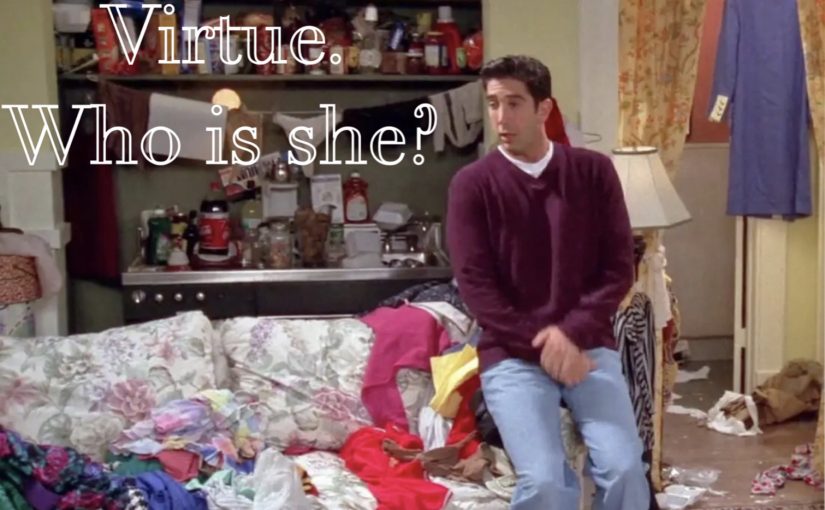
lazy/stoner boyfriend - Imgflip

Aristotle lists central virtues where individuals are expected to approximate the mean in their actions. We found that in this conflict, the values of friendliness, patience, justice, civility, and benevolence were most relevant.

A primary concern that must be addressed before any specific analysis proceeds is the contrast between the original poster (OP) and her boyfriend’s habits overall. It appears that OP has established a routine for keeping the house clean, she describes herself as a bit particular, but not so far in excess that she appears to be making an excessive fuss about the state of the apartment. This already indicates that she has aimed at a virtuous mean of moderation in her demands of others. The boyfriend, appears to be extreme in the actions described. Even if we take the story of him spending he entire workday surfing the web for new jobs o be true, the manner in which he spends his time is not balanced, and would now move him towards excellence in all areas of his life: his relationship currently being a primarily neglected area.

In analysis of OP’s boyfriend we can clearly see that he is not pursuing excellence and diligence, which are essential to evolving a moral life. He will be unable to become virtuous until he is willing to respond to the requests of his girlfriend, either by fulfilling them or by proposing another solution to the problem. In fact, if he feels that his girlfriend’s request are unjust, it is his responsibility to communicate that and request a change to the system, but it appears he has taken he role of excuses rather action. We also find that he appears to be falling under the vice of laziness, when it comes to maintaining the home and no hindering the flourishing of his girlfriend. The civility of his actions is also limited, as OP believes that he has been lying to her about what he is really up to all day at home. He is preventing her flourishing by  leveling both the problem of a dirty house and a deadweight boyfriend on her. If he has been unable to keep up with the chore of feeding their cats, he ventures into cruelty, which surely puts him at an extreme on the end of benevolence, as keeping non agricultural animals is ultimately an act of charity.

Our original poster is acting far more virtuously, with a few exceptions. Her diligence in working extra hours in order to support the two of them, her friendly firmness in her requests of her boyfriend, and her patience with him shine through. It appears that a central challenge in this conflict is her need to balance standing up for herself to assert what she feels is just, and understanding the stress and insecurity that her boyfriend may feel as the result of being replaced as head of household. OP notes that it has been five days had elapsed since her request, which we agreed was a long enough time for the boyfriend to fulfill her requests. Given the established trend of the boyfriend taking a long time to complete a task, as he apparently has been job hunting for months, she may not be properly assessing the situation and acting in line with a balanced amount of patience.

We have to holistically consider whether the actions of this deadbeat boyfriend are moving him towards eudaemonia, which for Aristotle is the ultimate goal. On his view, in fact good choices are the only way in which we can develop virtue. He states: “Virtue, then, is a state of character concerned with choice, lying in a mean,” (Nicomachean Ethics II.6). The boyfriend’s choices are currently taking him away from his progress because he is not putting good out into the world by making girlfriend happy. This negatively affects the girlfriend, and ultimately him by subjecting him to her anger and frustration. Maintaining this behavior will make him less happy because without diligence one cannot flourish. Finally, by avoiding the request and the work, rather the renegotiating or completing it, the boyfriend is not including himself in the cycle of virtue, action, and habit.

Based on all these factors group members reported different possible solutions to the issues presented. They are listed here in order from most to least lenient. Thees suggestions could also be used in a sequential manner: if he is non responsive to the first, OP should move on to the second one and so on. First we suggested the use of a chore chart, this would offer him structure that is lacking in work and offer small and satisfying goals in contrast with the slog of job hunting. This requires OP to further exercise the virtue of patience in waiting for him to improve, benevolence in believing in his ability to complete the tasks and intention to follow through. Next, we suggest a direct confrontation where the boyfriend is firmly told that he is not pulling his weight and OP requests that they split the chores at least 50/50. In this step, OP should express that if the boyfriend doesn’t act promptly, he is at risk of losing her. Finally, we suggest that OP leave him if he is unable to develop the habit of cleanliness. It does not bode well for a long term relationship when one participant cannot pull it together and when one party is not focused on moving towards a state of eudaemonia.

We finally have to consider, if OP proceeds through these steps, does it actually help her move towards eudaemonia? Our modern standard for cleanliness might seem extreme to ancients like Aristotle. However, the challenges of moderating the behavior of another in order to increase the wellness of a whole would appear very familiar. Ultimately, the challenge overcome by practicing effective communication and boundary setting would strengthen OP’s virtue. Though she already acts as head of household, it would further increase her self-sufficiency and resilience, which are values that bode well for the development of a virtuous character. In leaving him, she may lose the opportunity to better the life of another, which may not directly impact her degree of virtuous action.

By Group 1 (LG, GON, CS)

The Slothful Boyfriend

My boyfriend recently became unemployed and I picked up overtime at my job to make up for the lack of his income. As a result I am not around as much to keep the house clean, as he is home all the time I have been asking for him to help me out by cleaning up around the house (e.g. do the dishes, feed the cats, do laundry, clean the toilet, etc.) but without fail nothing is ever done by the time I return home from work. The first time this happened he claimed he got busy searching for a new job but we are on day five and I am becoming increasingly frustrated with him, now he claims that I am being “way too bossy and I am not his mom”. (excerpted from r/relationships).

Aristotle believed that through habituation anyone could become a moral, just, or good person. So everyone has the ability to be good but there is work and effort required to reach a good moral status, this is exactly what needs to be done in this scenario. It seems pertinent that you change your requests so they seem smaller and more do-able instead of what can be interpreted as a list of demands, try requesting a few small things and slowly adding to the list. 

It is also essential that you refrain from instigating arguments on this topic; Aristotle also believed that there are vices, the two extremes, and virtues, which are a middle ground. This also supports the idea that you should be lenient towards his behavior for a short period of time as you are showing the vice two vices, persistence, and a lack of acknowledgement.

Aristotle said

“courage is a mean with respect to things that inspire confidence or fear, in the circumstances that have been stated; and it chooses or endures things because it is noble to do so, or because it is base not to do so. But to die to escape from poverty or love or anything painful is not the mark of a brave man, but rather of a coward; for it is softness to fly from what is troublesome, and such a man endures death not because it is noble but to fly from evil.” (Nicomachean Ethics II.7)

With respect to persistence, you must find a balance where you slightly pressure your boyfriend to better himself without coming across as nagging or overbearing. For the lack of acknowledgement, again, there is a balance you must seek. This balance falls between acknowledging everything he does right and acknowledging everything he does right, there is a correct amount of praise that can be used and it is up to you to determine what that is based on the context of the situation. By doing this you are not just helping your boyfriend but you are also working on becoming a more virtuous person yourself.

In conclusion, Aristotle would have told you “It is well said, then, that it is by doing just acts that the just man is produced, and by doing temperate acts the temperate man; without doing these no one would have even a prospect of becoming good” (Nicomachean Ethics II.4). Nothing productive will be achieved if you continue to demand things from him, if this is the path you take the relationship you have built with him will almost certainly be unsustainable. If you do genuinely care for him you can help him become a better person by reevaluating how you act towards the subject of cleaning with him, by fostering a positive environment you not only in courage him to act morally but you yourself will also begin to lead a more moral life.

By Group 2 (IB, AC, JL, EW)

The One With the Dirty Boyfriend

Tl;dr: Have you ever felt that your significant other is being useless? Meet our protagonist (22F). Our protagonist has been working overtime to pay the bills while her jobless significant other (26M) has been “laying around” and “looking for a job”. Our protagonist wants him to help with household chores such as feeding the cats, doing the dishes, and cleaning the rooms, however, he chooses not to. The boyfriend leaves his dirty clothes and empty drink and snack cans in the living room. Our protagonist has already asked him nicely to help out while she’s at work to which he claims that he would (and has), but she claims that she has not seen evidence of this.

*Note that our protagonist has not specified what their living situation was prior to the S.O. being jobless.

According to Aristotle, the goal of human life is to flourish, and leading a moral life should lead us to flourish. In order to lead moral lives, we must build good character, which we can do through action. Aristotle’s morality is very character based; compared to other moral theories that are based in action and outcome, Aristotle would say that it is not only about the act and the outcome, but the intent behind the act and the consistency of those acts, because “moral virtue comes about as a result of habit” (Nicomachean Ethics II.1). In other words, we cannot just think good thoughts and hope for the best; we must consistently take action to do the right thing in alliance with our virtues. Aristotle describes virtues as states of character that are “equidistant from each of the extremes,” or the mean between the excess and defect (Nicomachean Ethics II.6). In order to build virtues, we must act on them until they become habitual, and we just do them. We should be doing the morally right thing because it brings us pleasure, and if it does not, then we need to habituate ourselves to do the right thing until it does make us feel good. Good acts and intent should be or become habitual acts, and it is these repeated acts that create good character. 

In this scenario, it is clear to see that the antagonist, the boyfriend, is exhibiting immoral behavior in deliberately disregarding his girlfriend’s requests. In Aristotle’s view, virtues are experienced as a spectrum between two extremes motivated by the individual’s needs to avoid pain and move towards pleasure. 

The following facts also may show us that virtue and vice are concerned with these same things. There being three objects of choice and three of avoidance, the noble, the advantageous, the pleasant, and their contraries, the base, the injurious, the painful, about all of these the good man tends to go right and the bad man to go wrong, and especially about pleasure; for this is common to the animals, and also it accompanies all objects of choice; for even the noble and the advantageous appear pleasant.

(Aristotle, Nicomachean Ethics II.3)

Yet, as shown by the boyfriends’ lack of regard for his girlfriend, it is easy to understand how his actions and decisions illustrate immoral behavior. A moral assessment of the situation on the boyfriend’s part would include the feelings and emotions of his partner proving the moral root of the issue; the lack of his intent. His insensitivity, poor character, and selfish judgements are preventing him from achieving virtuous behaviors while his selfish, pain-avoiding desires keep him at one extreme vice. Here, the imbalanced dynamic clearly causes tension within the relationship as the girlfriend feels caught at the other extreme vice of having to compensate but overloading herself to make up for his inadequacies. 

Now it is a mean between two vices, that which depends on excess and that which depends on defect; and again it is a mean because the vices respectively fall short of or exceed what is right in both passions and actions, while virtue both finds and chooses that which is intermediate. Hence in respect of its substance and the definition which states its essence virtue is a mean, with regard to what is best and right an extreme.

(Aristotle, Nicomachean Ethics II.6)

As this cannot persist, there are a few venues the girlfriend can take in hopes of altering her partners behavior. Each option is then assessed for most accurate moral analysis as would be determined by Aristotle. 

According to Aristotle, the goal of human life is to reach eudaimonia, also known as human flourishing. In order to do that, you have to live a virtuous life and successfully do your function. Aristotle himself writes, 

The function of man to be a certain kind of life, and this to be an activity or actions of the soul implying a rational principle, and the function of a good man to be the good and noble performance of these, and if any action is well performed when it is performed in accordance with the appropriate excellence: if this is the case, human good turns out to be activity of soul in accordance with virtue, and if there are more than one virtue, in accordance with the best and most complete. 

(Aristotle, Nicomachean Ethics I.7)

In other words, one is moral if their actions coincide with their function. In Aristotle’s perspective, the boyfriend is immoral as it is not a rational thing to keep one’s living space dirty and not have a job which further hinders his and his girlfriend’s chances of reaching eudaimonia.

Habituating virtues: There are a couple things that the girlfriend can do about this problem. She can praise him for the things he does around the house or whenever he does something that was asked of him. Although praising him for something he should have done in the first place doesn’t seem reasonable and is not her job to do, especially since she is already busy working overtime, it is a way of operant conditioning which is how you modify behavior. He will associate the act of cleaning with a positive benefit, therefore keep cleaning. This will turn into a habituated virtue. Another suggestion would be to consider breaking up as the boyfriend isn’t keeping her best interest in mind and is not succeeding at his function. Although the act of cleaning the apartment is not immoral, the intent behind the actions can be seen as morally wrong. The boyfriend has been asked multiple times and can clearly see that it is frustrating his girlfriend. By ignoring her wishes purposefully, his actions are seen as immoral. The two can be referred to as incompatible and if they can’t find an acceptable compromise or she can’t lower her expectations, sticking around will only cause more arguments and will not lead to human flourishing for both parties involved.

Responding by lowering her expectations: One possible stand the girlfriend can take would be to subliminally respond to her partner’s lack of appreciation by reciprocating in effort and expectation. In doing so, hopefully the boyfriend’s hypocritical behavior will become apparent, incentivizing him to help reach the same goal as his partner. While he maintains his expectations of her, he fails to complete even the simplest of tasks in response. If she were to respond by stopping completing other tasks, he maintains for her, grocery shopping, cooking dinner, laundry, etc., hopefully, he would be encouraged to contribute with the expectation of being able to share in enjoying the rewards. In this way, the girlfriend is slowly and subconsciously positively conditioning her partner rather than directly confronting the situation. It is here that questions of Aristotelian morality come in. While this method could prove effective, Aristotle would most likely argue that this task lies not with the girlfriend but within the boyfriend. Ultimately, it is not within the girlfriend’s jurisdiction to decide when, how, and what the boyfriend is conditioned to do. Here, we only have one side of the issue attempting to mediate its counter which most likely will not provide a sustainable solution. Seeing as the parties are representing almost polar stands on the issue, it will require both to contribute to a more permanent long-term agreement. 

Reaching compromise: One thing to note is that our protagonist has not specified what her definition of “clean” is. She states, “I’m very particular about [how the shower and toilet are cleaned] and usually do it myself but again, working overtime every week is pretty exhausting.” This statement could lead one to think that our protagonist is holding her S.O. to her standards which, while useful in helping her to define her own particular needs, could also be the cause of some friction between the couple. After all, she also states that her boyfriend has now started to respond to her requests by saying that “[she’s] being way too bossy and [that she’s] not his mom.” From the Aristotelian perspective, what we have here are two possible extremes: our protagonist’s wishes (and her definition of “clean”) and her boyfriend’s wishes (how he wants to spend his day and his definition of “clean”). Aristotle believes that virtues are the middle-ground between two extremes and that only through virtues can there be true success. If we apply this philosophy of extremes to our lovely couple, it might be suggested that both parties reach a compromise. To the protagonist, we understand your desire to come home to a clean space after working all day, but by placing your particular expectations of cleanliness on your S.O., you have created an environment that may be harmful on both parties’ behalfs. It’s even possible that your boyfriend no longer feels safe to express his needs to you since all he ever gets told is that he’s not doing enough. It is our suggestion that a compromise is reached between both you and your significant other (e.g. “wash your own dishes/clean up after yourself and I’ll clean the bathroom when I return”) such that neither of you feels like you are living in both an unhealthy environment and relationship.

By Group 3 (ML, RM, NM, KR)