TLDR: The poster’s boyfriend has recently lost his job. Due to this, she is working overtime to support them. She asked him to do the dishes, feed the cat, and a few other housekeeping tasks to cover for the overtime she was spending at work. Not only has he “forgotten” to clean up multiple times, he consistently leaves the house a complete mess. After OP reminded him nicely to start taking a more active role, he was rude to her and suggested he shouldn’t have to clean.
In Nicomachean Ethics, Aristotle begins by positing that the aim of all human action is eudaimonia, roughly translated as ‘flourishing.’ This is his conception of the way that human beings continually grow and evolve throughout their lives, both intellectually and emotionally, to achieve ‘the good life’, an authentically happy and fulfilling experience on Earth. This pursuit never ends, and is made up of many virtuous decisions. According to Aristotle, only those activities that are done with the purpose of increasing flourishing are truly moral.
In Book 2, he fleshes virtue and the way that it creates his conception of morality. He concludes that it is a balance between excess and deficiency, and repeatedly stresses that being virtuous is hard, and something that citizens need to work to learn. Differentiating ourselves from any other animal, however, is our capacity to reason, which allows us to make the decisions that create a virtuous life. “Virtue is a state of character concerned with choice, lying in a mean [between excess and deficiency] … determined by rational principles” (NE 2.6). Beyond this, however, there are many character traits that make up a virtuous person. Traits that are either in excess or deficiency in regards to the situation at hand will be vices, as they fail to rationally discover the ideal mean. For example, courage is the virtuous mean between cowardice and rashness (NE 2.7). Shyness and shamelessness are on either extreme of modesty, and when it comes to money, Aristotle writes that “the mean is liberality, the excess and the defect prodigality [extravagant spending] and meanness” (NE 2.7). Your moral character is built by repeatedly making virtuous decisions, and fully realized virtue means that these decisions become second-nature, as there is no need to even consider the less virtuous options.
Aristotle’s definitions of virtue are often in contrast with other concepts – virtue, for example, is finding the right balance of excess and deficiency. By stressing the importance of human reason, he claims that he does not have to provide specific definitions because all humans will be able to determine what is actually virtuous on their own.
Jack’s Opinion: When it comes to applying this moral theory to the moral problem at hand, the poster is clearly justified in being upset at their boyfriend. First, the boyfriend is clearly not acting virtuously – he is being lazy and unclean (deficient) and rude (excessive) which make his actions clearly immoral. Even though he doesn’t personally seem concerned about the trash and lack of cleanliness, so his temporary happiness may not directly be at stake, he is impacting another person’s life significantly with his actions. This relationship is part of his life, and by choosing not to respect his partner he is both straying further from virtue and making it harder for the poster to achieve it by placing additional burdens on them. In contrast, the poster is attempting to help him through a rough patch by taking on extra work, and doesn’t want to have to continue to spend energy attempting to convince their boyfriend to be virtuous.
Jules’ Opinion: The person creating the post is justifiably angry, because I hate this dude and I’m not even dating him. He lives in her house (and my mind) rent free. The boyfriend is possessing little virtue, being extremely lazy and not fulfilling his end of the deal. He knows what is expected of him and continues to act in a way that he knows will strain his relationship and will negatively impact her flourishing. He is acting with Vice in his gluttony and laziness. Selfishness is not virtuous. I think she should break up with him and get a girlfriend. The poster is even being extra generous by taking care of the needs of someone they care about, putting in more work trying to convince someone who clearly doesn’t care as much to be a good person and to treat them with respect. ick
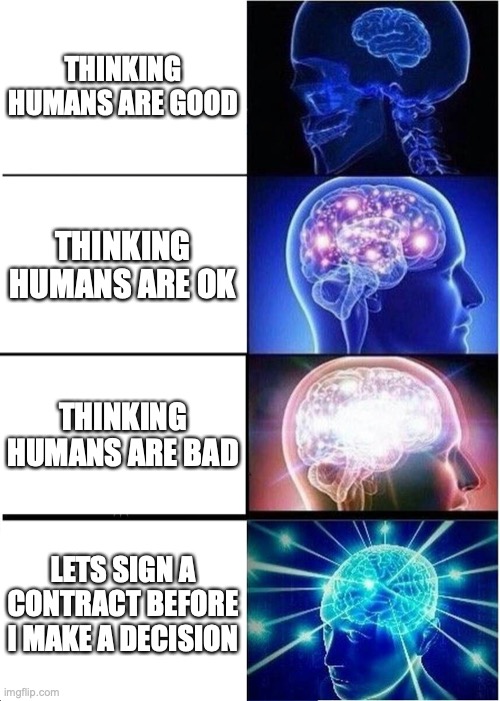
Toby’s Opinion: I believe that the boyfriend needs to get off his ass and help around the house. Not only is this an immoral thing to do but, he is being unethical. I get it you lost your job and times are hard, but there is no reason that you should be sitting around doing nothiNg THe Girlfriend is not an asshole in fact I must applaud her restraint. In Aristotle’s wrong opinion on he is finding the virtue in most parts as of the current situation. That he is fulfilling when in regards to Aristotle is that he is not being virtuous. To conclude they are living together and made a deal about the living situation, yet the boyfriend is going with a Hobbsian theory of contracts, even though they need not write one as there was one that was verbally said when they moved in together.
Cailin’s opinion: The boyfriend is the asshole in this scenario in my personal opinion. In the Aristotle’s view while the boyfriend is following what would make him happiest and is following pleasure which can be seen as striving for eudaimonia. However, at the same time the extent of his laziness can be considered a vice because it goes to the extreme end of the spectrum where he is being neglectful to his space and his girlfriend.