Kant on capitalism and moral obligations to others.
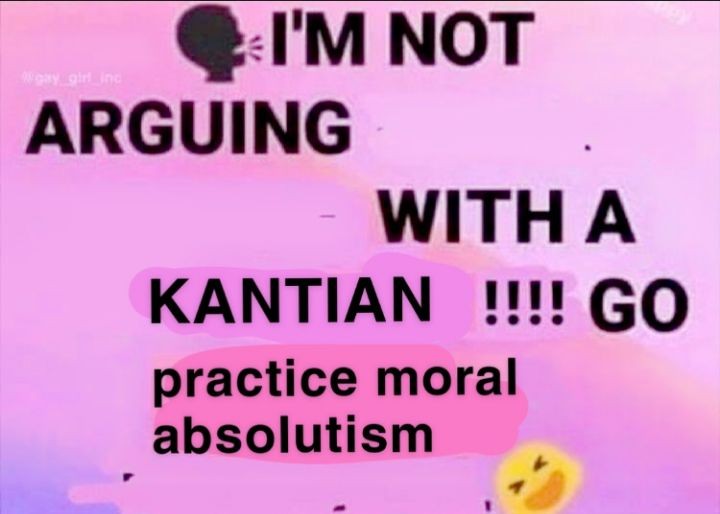
In terms of the ethical standard problem, Kant states that “the categorical imperative is thus only a single one, and specifically this: Act only in accordance with that maxim through which you can at the same time will that it become a universal law,” (Ak 4: 421). To determine whether or not the maxim is universalizable one must first establish the maxim, then consider what the corresponding universal law would be, and finally determine whether or not this universal law is plausible or if it presents a conceptual contradiction. If a maxim being universalized presents a contradiction then one must not do it because it is “impossible to will that their maxims should be elevated to the universality of a natural law, because such a will would contradict itself” (Ak 4: 424).
Kant also presents a second way of considering his ethical standard saying that one must treat “the human being… as end in itself, not merely as means to the discretionary use of this or that will,” (Ak 4: 428). This is to say that one cannot simply use another human being as a means to an end but instead must consider them as an end in and of themselves. Kant also distinguishes between perfect duties, which are the exceptionless imperatives that state one cannot do some action, and the imperfect duties which are those that one ought to do but do not have to do in every situation.
Ethical Consumption Under Capitalism
Is the term “no ethical consumption under capitalism” true? And if so, is it even possible to live a virtuous life if capitalism exists? If it isn’t, is it possible to create an ethical system that allows for virtuous living and what would it look like?
What does Kant define as ethical?
“There is nothing it is possible to think of anywhere in the world, or indeed anything at all outside it, that can be held to be good without limitation, excepting only a good will.”
(9; Ak 4: 393)
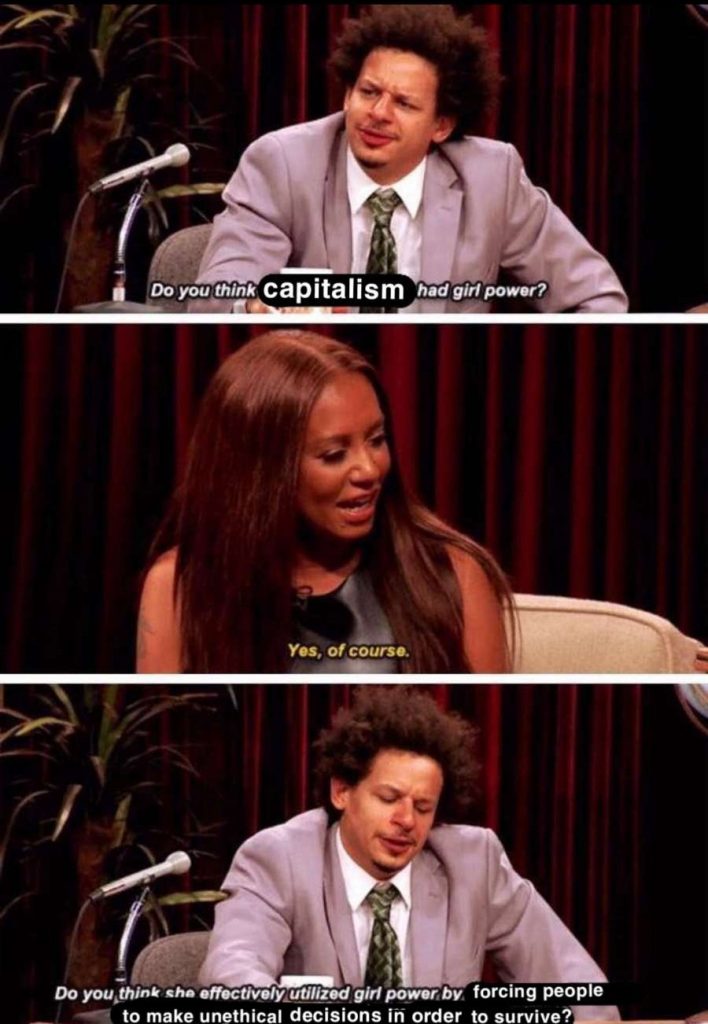
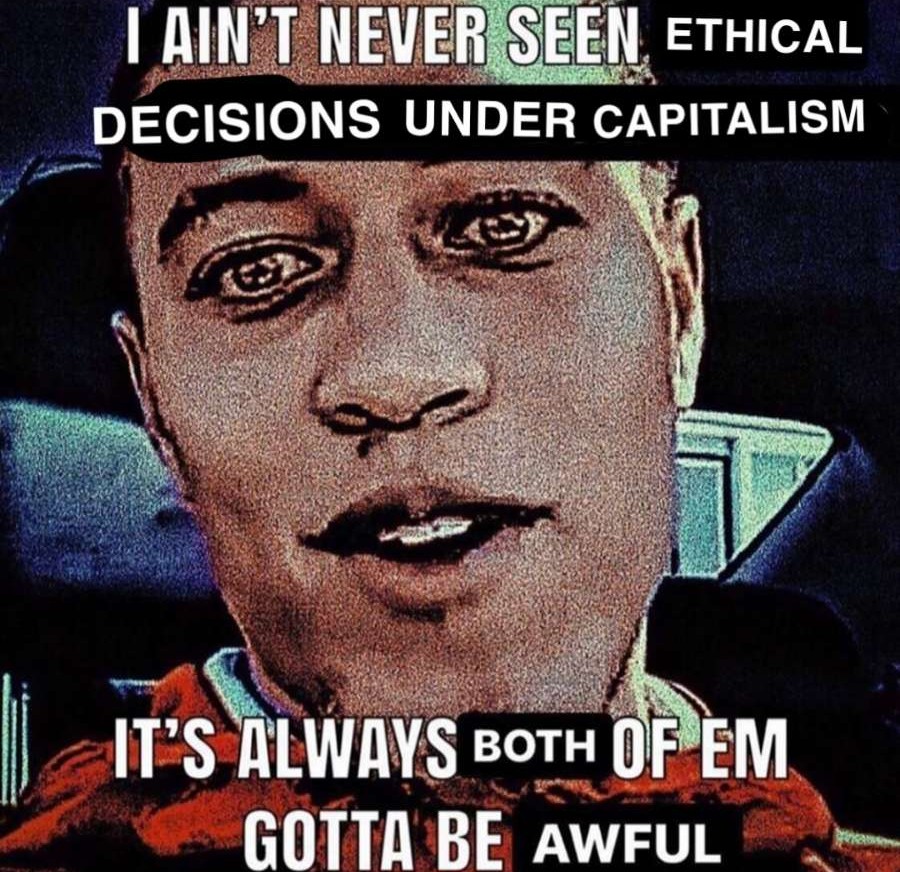
Kant provides a framework that claims that the only thing that is purely good is good will. Kant says that universalized maxims can inform one on how to act. If it cannot be applied to every situation, then it is not an ethical decision. The good place does a good job deconstructing the ethical implications of capitalism. Capitalism is an economic system in which there are the people in charge of the means of production and there are the working class who are often exploited and used as means rather than ends. In order for one group to maintain power and excess of production, another group must be kept down and oppressed. That means that when it comes to consumption, there are hardly any good decisions to be made. A good example of this is in the good place when Chidi is debating what type of muffin to get for breakfast. He is trying to calculate harm reduction and the lesser of two evils, but regardless of the other options, they are both still unethical because of the working conditions people face in order to produce these. Bad things are still bad regardless of the circumstances you have been put in.
Kant would likely criticize the people who formed and participate in this system that gives people little to no option about whether or not they do the right thing, especially because companies and powerful people work hard to mask their immoral behavior. You can’t make autonomous decisions if you don’t have all of the information—the fact that corporations and participants in the system treat workers as means shows that capitalism itself is an immoral system, therefore participation in it is inherently bad. The only way to act ethically is to defy capitalism—so it is likely that Kant would agree with the phrase “no ethical consumption under capitalism.” This doesn’t mean that you cannot live ethically if capitalism exists but only if you are not an active participant in said society.
Kant would say that there’s no inherently ethical system for virtuous living, but a better system would allow for individuals to better make informed decisions because they would be aware of the consequences of what the system is doing. A better system would also encourage doing the right thing rather than rewarding people for selfish behavior. The way Kant’s theory works is that people do the right thing out of duty. A better system would be one with more accountability and transparency, which would directly link to more people acting upon these duties and having more ethical options.
To tie this into the trolley problem, categorical imperatives are commands that you must do regardless of your desires. Kant would likely criticize capitalism for being the system that puts people in the position of being tied to railroad tracks in the first place, and putting the responsibility on others to make decisions (e.g. pulling a lever) that would still lead to an unethical decision. This however, does not change the fact that the action you take under capitalism is that you are often forced to pull the metaphorical lever. Even if you are forced to do a bad thing because of your circumstances, it’s still not morally permissible.
Moral Responsibility to Educate Bigoted Housemates
“A is the only minority within an otherwise homogenous group (let’s say B, C, and D are the rest of the members), who all live together under one roof. While each individual in the group has good intentions and are against any form of bigotry, members of the group unknowingly commit micro-aggressions upon A. A vocalizes these concerns to the group, and is met with uncomfortable silence. B, C, and D don’t want to see themselves as bigots, so they choose to ignore A’s concerns. A recognizes that they themself are not responsible for educating B, C, and D on micro-aggressions, and chooses to spend less time in the house. B, C, and D see A spending less time with them as a sign of rudeness (and during the pandemic, they also see it as a lack of concern for their health), and collectively begin to resent A more and more as time passes.
A is aware of all of this. A wants to educate B, C, and D on their behavior but simultaneously recognizes how futile the endeavor is. A wants to respect themself and their identity by leaving the house, but simultaneously does not want B, C, and D to resent them. Both action and inaction make A’s life more difficult. A does not want to leave this housing arrangement because it would be too financially burdensome, but at the same time recognizes their own deteriorating mental health the longer they stay.
If B, C, and D refuse to change, what obligation does A have to fixing this problem? A can’t completely remove themself from the house, and, with every effort to try to fix the situation, A recognizes that they are being drained of their autonomy and self respect. I am not looking for a solution to this problem (I want to make clear that there is no real one under the condition that B, C, and D refuse to participate), but rather, what obligation does A have to improve their life even if they know fully well that there will be no progress? Is there any obligation to resist oppression at all if all avenues for progress are barred?
An alternative way to say the same question: what obligation does A have in improving their life if both action and inaction result in a net decrease to their well-being?”
There is a lot to unpack here, so I’ll address this in chunks.
“A recognizes that they themself are not responsible for educating B, C, and D on microaggressions”
If the maxim here is I am not responsible for educating people on microaggressions, then the universal law would mean that no one is responsible for educating people on microaggressions. We’ll say that microaggressions are immoral, because if they go unnoticed, they can lead to worse immoral discrimination against groups down the road. Thus, saying that no one is responsible for educating people on microaggressions is impossible, because microaggressions themselves are immoral, so letting them go unnoticed is an immoral act. So, the maxim becomes everyone is responsible for educating people on microaggressions, and no one is exempt from this. If it is a maxim, Kant would say we have an duty to do it even if it goes against our own desires. So, unfortunately, Kant would say that it is your duty to educate your housemates on their microaggressions. However, the outcome itself doesn’t matter; if your housemates choose not to listen, as it seems they are not, it is not your duty to make them listen.
“B, C, and D see A spending less time with them as a sign of rudeness (and during the pandemic, they also see it as a lack of concern for their health), and collectively begin to resent A more and more as time passes. “
Kant says we have a duty to not lie, under any circumstances. However, this is different from not telling the truth. If your housemates are not directly asking you why you are spending less time in the house, it is morally permissible to not tell them. But, if they have asked you, it is your moral duty to tell the truth: that you are leaving the house because the environment they have created is uncomfortable. While the truth hurts in cases like this, telling your housemates why you’re leaving the house may lead to a better discussion about the negative environment they have created for you.
“Is there any obligation to resist oppression at all if all avenues for progress are barred?”
Let’s start by formulating a maxim. Here, it seems like the question would lead us to I will not resist oppression because all avenues for progress are barred. Now, let’s universalize it: Everyone will not resist oppression because all opportunities are barred. If no one resists oppression, no progress in society will be made, and the opportunities that are there will be thrown away. So, it seems like it would be a duty to resist oppression because if one does not, they perpetuate the oppression in society. Just because resisting oppression doesn’t seem to work in every instance doesn’t mean we shouldn’t do it, because resisting oppression furthers humanity and the autonomy of the oppressed communities.
Synthesis
Kant said “Act so that you use humanity, as much in your own person as in the person of every other, always at the same time as end and never merely as means” (AK4:429). Both problems are problems because they have created a world where it is acceptable to use people as a mere means, like how a cup is used to hold water. The first problem specifically asks about the ethicality of consumption within a capitalist system, Kant would most likely argue that capitalism does treat people as mere objects, so therefore it is an unethical system. This can be seen with companies like Apple and Nike who pay workers in other countries a minimal salary for work in unsafe conditions to produce a product, another example of this is the use of undocumented immigrants in agriculture as a way to pay a fraction of the price for seasonal labor. This system has essentially universalized a law allowing for those in charge of a company to use their employees as a mere means to achieving a large profit, which most people including Kant would say is wrong.
In the second situation we are faced with a similar but slightly altered conundrum. As per how the situation is described to us it seems apparent that persons B, C, and D find it acceptable to allow for their microaggressions to run rampant and destroy the relationship they have with their fourth housemate. It seems as though this majority is aiming to not be viewed as discriminatory whilst still acting in ways that are bigoted, this in itself is immoral because it creates a world with a condriction. This means for them to achieve this goal they must write off or discredit what person A is attempting to convey to them, phrases such as “it is just a joke” or “you are overreacting” achieve just that. By using similar phrases or by ignoring person A altogether the other three housemates are able to use person A’s emotions against them to ultimately achieve their goal, whether it takes the form of person A being less present around the house or ultimately moving out. So if person A is not around to inform them of the bigotry in their actions then they have no reason to think they are doing anything wrong, which enables bigoted behavior.