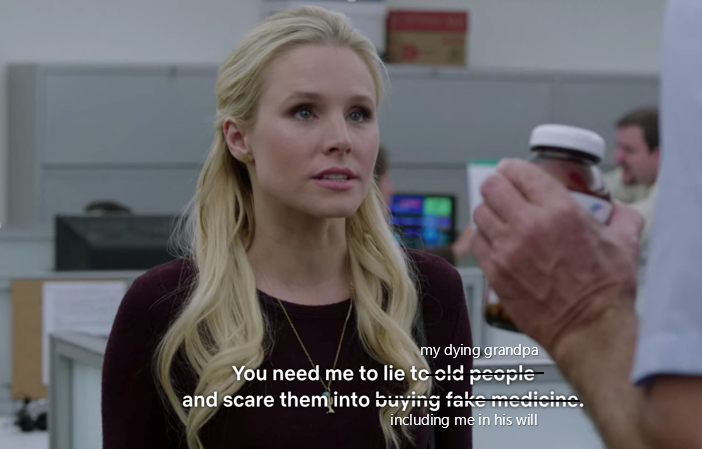
Tl;dr of your situation: your grandpa is a real POS. But a rich POS (of course). He hates your family, but you are considering sucking up to him by putting up with and echoing his racist beliefs in order to get written into his will. Assuming it works out, you will use your new-found money to pay for college and to give away to charity. Your mom is all for this idea, but your dad isn’t convinced. What to do?
I’m about to answer this question with a little help from Hobbesian morality. Hobbesian morality is all about keeping your promises (covenants) with people. As long as two parties make a covenant with full knowledge of making it as well as what it entails, the covenant is said to be valid. To keep your covenants is moral, to break them immoral. And prior covenants always take precedent over later ones.
Now, here’s my answer: suck up to that POS. Go as nuts as you want, your morality will remain intact. Just like Obi-Wan, you will have the high ground. Assuming that you are able to convince your dad that this is a good idea, though. This is because (if your dad is okay with it) you will not be breaking any covenants (assuming that you haven’t made a covenant with your grandpa to NOT suck up to him, which I doubt) with any party. From my understanding of your situation, as long as you are able to get your dad on board with this, you will indeed NOT be the asshole according to Hobbesian morality, because you will have violated 0 (zero) covenants. Hell yeah.
The scenario of the “Racist Grandpa” discusses a grandson being in a moral dilemma towards his Grandfather. The grandson describes his grandfather as a “jerk” because he holds anti-Semitic, racist, and xenophobic views. He has a swastika tattoo and proudly announces his dislike of others to his own family. The dilemma arises where the grandfather is ill with cancer and has 9 months to live. The grandson, who vehemently disagrees with his grandfather’s views, wonders if he should visit him and join in with his racist slurs to gain benefits within the will. The grandson has conflicting views on this action/topic as his mother is all for it while on the other hand he/his father are weary.
Hobbes’ view of morality and human life is based primarily on self-interest. Hobbes believes it is one’s nature to live a life of self interest in the hope of gaining one’s desires. Hobbes believes that all men are made equal but “From this equality of ability ariseth of hope in the attaining our ends” (94). Hobbes believes that due to human equality it is our duty as people to “attain […] our ends” which suggest that it is moral to pursue our own desires which exhibits the morality of self-interest. Hobbes further states that “The passions that incline men to peace are fear of death, desire of such things as are necessary to commodious living, and a hope by their industry to obtain them” (97). Hobbes is stating here that morality is driven by “fear of death” which affects our decisions regarding our preservation. He also states that it is our duty “to obtain them” as they benefit our self-interest further revving morality is based on self-interest. Finally, Hobbes idea of morality based on self interest is further exhibiting when he writes, “The right of nature which writers commonly call just natural, is the liberty each man hath to use his own power as he will himself for the preservation of his own nature; that is to say, of his own life” (98). Hobbes comparing “the right of nature” to “the preservation of […] life” exhibits it is within man’s power and right to live by self interest if it leads to his conservation.
From Hobbes perspective of morality and self interest he would believe that the grandson lying and taking the cash would be morally ok. Hobbes would believe this because he discusses that morality is based on self-interest and preservation. The grandson says that if he receives the money he would “give 25% to charities, 25% to my dad, 25% for my mom, and 25% to me to help pay for college”. His actions of not only caring for his own self preservation and education but those of others is an indicator that it is in his right to take the money. Hobbes would believe this because, as stated within the previous paragraph, we as people can obtain our ends to secure our preservation or “commodious living”. As well, it would be morally ok for the grandson to “hope to obtain” the money through the transaction of sucking up because Hobbes believes no gift is free. This idea is seen when he writes, “When the transferring of rights is not mutual, but one of the parties transferred in hope to gain thereby friendship or service from another or from his friends; or in hope to gain the reputation of charity or magnanimity, […] , is not a contract, but a GIFT, FREE, GIFT, GRACE” (101). Although there is no verbal agreement between the grandson and grandfather in getting the money the grandson is giving up his rights in the present to ensure his future that he will reap benefits. Hobbes states it is moral to have hope of self interest in one’s future to gain the reputation of “charity or magnanimity” which the grandson is striving to do. The grandson hopes to gain magnanimity to obtain his grandfather’s approval to be written within the will. Finally, Hobbes states,“The matter or subject of a covenant is always something that falleth under deliberation; for to covenant is an act of the will that is to say, an act, and the last act, of deliberation, and is the for always understood to be something to come […]” (105). Within the grandson to grandfather scenario the line “act of deliberation […] is always understood to be something to come” connected to a covenant, reveals that the hope of preservation or benefits based on self-interest for the future is what morality is based upon. The grandson is taking care of his future and “something to come” through his own “act of deliberation” or befriending his racist family member which implies through Hobbes view of morality that a life driven on self interest is not only normal but moral. This would mean it is within the grandson’s right to act upon his future whether it is selfish or not.
TL;DR: An individual wants to “suck up” to their dying racist grandfather, with whom they do not like and neither do their family members, in order to be written into their grandfather’s will for his inheritance. The individual tried to make his grandfather’s last days the best days that included a sense of comfort and a feeling of love.
By Hobbesian technicality, the actions of both actors are moral when you consider their specific contract. The implicit contract in question is that everyone has a right to be in their family member’s will (should they already have been included).
Hobbes’ views on morality remain ingrained in a set of laws that, they themselves, define morality for the society. One way this is accomplished is through a set of binding contracts (based in these laws) that individuals make with others to perpetuate morality through to others. It would be immoral to break that contract. This concept conflicts with the situation in a few ways, first there is the issue of whether or not Hobbes would even see a contract here considering the grandfather was not fully aware of the full extent of their interactions.
If we do consider there to be a real contract, the actions of both the grandson and the grandfather are moral because they both are fulfilling the commitments/actions required on their part to complete the contract. This, of course, is rooted in Hobbes’ idea that morality is based on the rules and contracts we make and enter; thus, this would be moral because the contract was not broken.