Are individuals justified in wishing death upon Donald Trump?
Should we wish death upon a sitting president, and is someone justified to do so. The maxim in this is “I will wish death upon someone who is morally despicable to achieve personal gratification. Thus the categorical imperative is the moral obligation that you get when you follow that maxim. Does Trump’s despicable nature justify those thoughts and would Kant believe such a thought to create an impossible society?
The purpose of such thought is primarily to prevent violent action by providing some level of personal gratification. Therefore, this is the maxim for this particular prompt: Everyone who wishes death upon someone who is morally despicable achieves personal gratification. To test its universalizability, we have to argue whether the subsequent law of nature would produce a contradiction. To reach that conclusion, our group discussed the universalizability of the following statement: Everyone who wishes death upon someone who is morally despicable achieves personal gratification. In this specific case, a wish does not constitute a physical action. Wishing things is simply the act of thinking, which by all accounts, is something everyone can do. Moreover, one individual’s thought, if kept to themselves, does not cancel the ability for another individual to think. Therefore, the act of thinking does not produce any contradictions, which according to Kant, confirms that a society is possible to exist under this maxim. This maxim is morally permissible and does not violate the categorical imperative. With this in mind, individuals are justified in wishes directed toward morally despicable individuals.
I have strong romantic and sexual feelings for one of my previous teachers, whom I am very close with, have known for years, and deeply care about. I am of age and she has never made any advancements towards me, but I have this feeling that the bond we have is deeper than platonic. To be honest, I’m not sure if the bond is real or if I’m just delusional. I feel as though I’m betraying and taking advantage of her by thinking of her like this, but the feelings do not go away. I’m worried this will ruin our relationship if I tell her, so I know it’s best to ignore it yet still find it impossible. What are your thoughts?
The purpose of confessing feelings to an authority figure is to achieve full honesty and transparency. The law of nature connected to this maxim is that everyone who expresses romantic feeling will achieve full honesty and transparency. The question of whether this maxim would force a contradiction will be examined in the following paragraph.
Before we advise this individual, we’d like to make a note that, to make our Kantian analysis, we are giving this individual the benefit of the doubt that they are treating their former teacher as both a means and an end. Moving forward, we have identified the maxim of this question as being, I will tell my former teacher how I feel about them to achieve total honesty and transparency. We have also identified the corresponding law of nature, which goes, Everyone who expresses romantic feelings to an authoritative figure achieves total honesty and transparency. Now comes the big question: are these statements universally true? The answer is yes. We believe that both statements will result in zero contradictions for the immediate result (with regard to the purpose). If anything, the only contradictions that might exist are in the side effects, but Kant has emphasized that his test of universalizability does not consider effects beyond that which is the intended purpose.
Given that the maxim has been deemed universal, we can confidently suggest the individual that, should they decide to tell their former teacher, they will not have done anything that is morally wrong or unjust. We emphasize that the individual is not morally obligatory to confess to their former teacher, only that it is simple permissible.
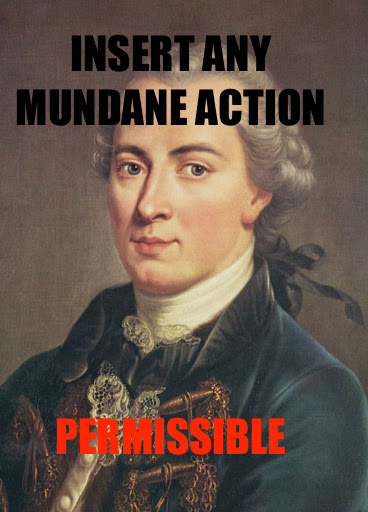
The Permissive Nature of the Categorical Imperative
Our moral advice here stems from the fact that, in accordance with Kantian morality, many actions are indeed permissible (and moral). This is because whether or not an action is permissible hinges on the maxim itself and its universalizability, rather than the consequences of that action. This is to say that if the maxim (or the framing of the action, i.e. “I will do ‘x’ in order to ‘y’) is found to be universalizable (resulting in no contradictions at all) according to sound logical reasoning, then the action is entirely permissible and moral.
For the first prompt, our conclusion that wishing death upon a sitting president is justified (or at least a permissible thing to do) was reached by following this reasoning process. Even if someone were to disagree with this conclusion, we found it to be universalizable under Kantian morality because it does not result in a contradiction.
This same line of reasoning holds true for the second situation as well; no contradiction is created by one willing this action (being upfront with romantic feelings for a former teacher) to be universalized. Again, one might stand in stark disagreement with this action, but because it does not strictly result in a contradiction given the maxim that we have established, it is entirely permissible.
To reiterate, the most important aspect to note in understanding our Kantian advice for these two situations is that Kant’s philosophy has nothing to do with the consequences of actions, but rather their universalizability.